EU alcohol labelling
Home » Our work » Campaigns » Alcohol labelling » EU labelling regulations
Introduction
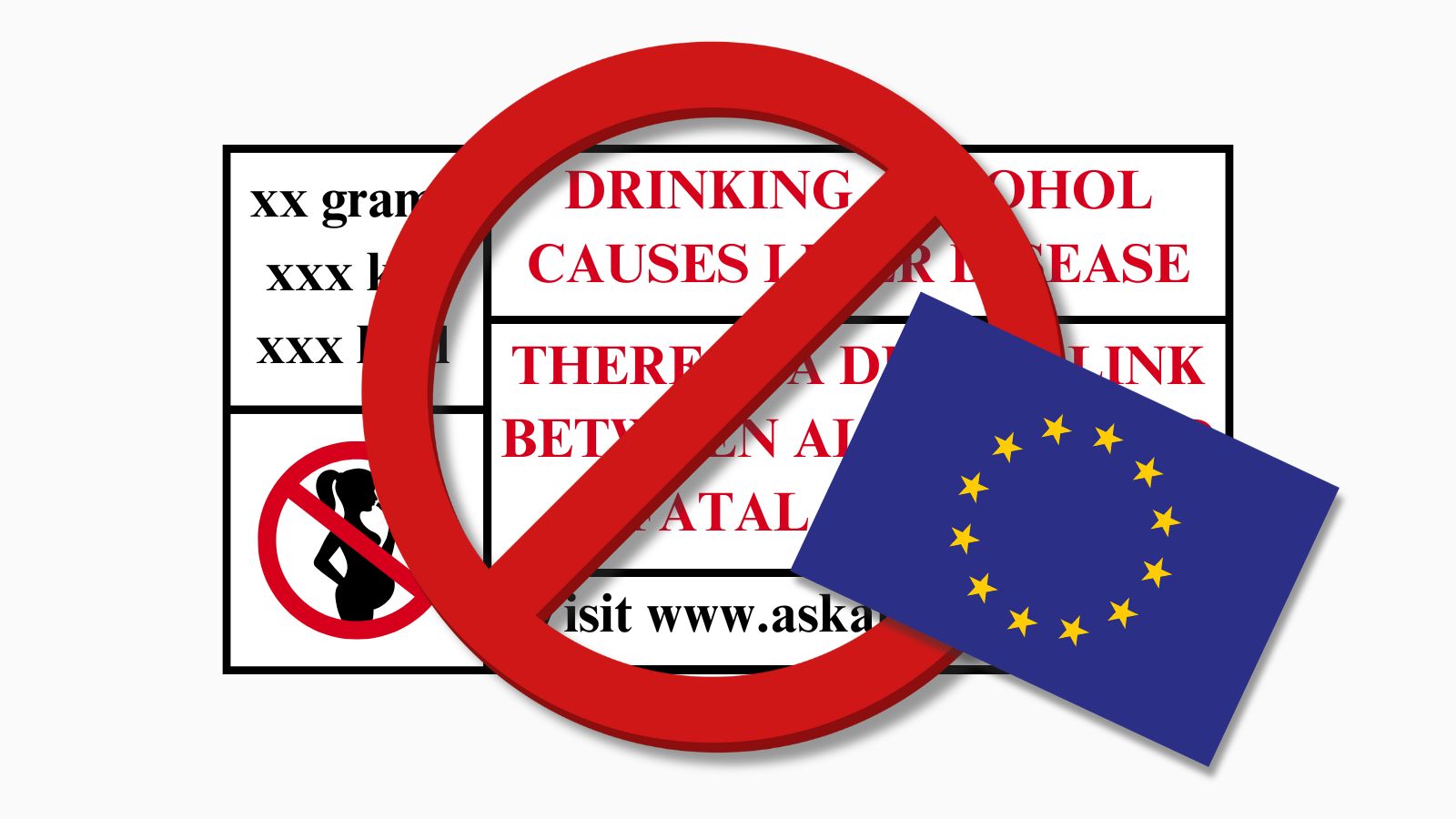
Suggestions that the Irish government might abandon its plan to introduce health labelling on alcohol products and instead move the issue into Europe must be resisted as there is no harmonising EU legislation on the use of health warnings on alcohol products.
Such a move would play right into the hands of the alcohol industry, which has fiercely resisted labelling at every turn at national, EU and international level, and operates a highly organized lobbying network within the EU, leveraging its economic and cultural clout.
The move would end any hopes of ever seeing health warnings – particularly cancer warnings – on alcohol products in Ireland.
The power of the alcohol industry lobby has been felt before at EU level.
- In 2011, when decision makers were negotiating the Food Information to Consumers (FIC) Regulation, the alcohol industries lobbied hard (and successfully) to be given a special exemption from providing ingredients and nutritional information on the label.
- Europe’s Beating Cancer Plan, launched in 2021, was a rare opportunity to align EU alcohol policy with public health priorities. Instead, it became a case study in how powerful lobbying networks can dilute transformative initiatives.
READ Europe’s Beating Cancer Plan: How Big Alcohol lobbying diluted a historic public health breakthrough by Emil Juslin, Director of Advocacy at IOGT-NTO
Background: EU is an organisation centred around trade
The EU, since its foundation as the European Economic Community (EEC), has always been an organisation centred around trade and commercial interests. While the EU now aims to be an all-encompassing organisation, its history does affect its ability to do so. Many structures, policy processes and policy evaluations are built based on how to ensure increased trade and sales. Similarly, most established metrics for policy success are primarily commercial.
This has made policy progress in fields that have other values difficult, especially in policy areas where the profit interest of the industry is in opposition to the public good (some examples are tobacco, alcohol and environmental questions).
Case Study: EU Wine Package (2026)
In February 2026, the Council of the EU approved a set of measures to support the EU wine sector.
The core of the package is that additional funding will be made available to the wine sector to adapt production to market developments such as declining demand, overproduction, and demand for non-alcoholic beverages. Funds will also be made available to stimulate the promotion of EU wine globally.
Agreement was reached on the designation of de-alcoholised wines. Wines with a maximum of 0.05% alcohol may be sold as 0.0 wine, and those with a maximum of 0.5% alcohol may be sold as alcohol-free wine. The wine sector’s lobbying for the right to call de-alcoholised wines up to 6% alcohol “low-alcohol” was quite rightly rejected. It was agreed that these may be called “reduced-alcohol wines.”
Importantly, the Wine Package maintained the current situation that nutritional information and ingredients do not need to be included on wine labels, unlike almost all other products in stores.
The wine industry had long argued that a QR code on the label, which consumers could scan and be directed to a website, was preferable to written information on the product. Health organisations viewed QR codes as, in practice, a barrier to informing consumers and studies showed that few consumers scanned the codes (6 out of 7,079 people in fact).
Health organisations and academics were not part of the discussions on the wine package and the wine producers got their wish.
The Wine Package advanced without a single assessment of how the boost of the EU wine industry will affect public health. This is extraordinary in an union that routinely demands environmental, economic, or gender impact assessments for almost every other policy proposal.
Furthermore, the European Parliament did not even hold an open debate on it. In November 2025, the Agriculture Committee adopted both the Wine Package and granted itself a direct mandate to negotiate with the Commission and the Council – skipping the plenary entirely.
Perhaps most troublingly, public health organizations in civil society were excluded from the process altogether. While industry representatives were invited to multiple high-level meetings with the Commission and its services, health and consumer groups were rejected from taking part. No meeting minutes were shared, no stakeholder consultation opened, and no opportunity given for independent experts to present data or perspective.
For those who work to reduce alcohol-related harm, this silence has been deafening. The message it sends is unmistakable: the interests of producers matter more than the wellbeing of citizens.
The 2024-2029 political landscape of the European Parliament
The makeup of the European Parliament shifted right in the last European elections. This means that Europe is increasingly becoming a cold house for civil society groupings.
In May 2024 the European Commission issued new guidelines for EU funding, intended to block or cancel funding to NGOs involved in activities that may “damage the reputation of the EU”. At the heart of this is an attempt to prevent NGOs from doing advocacy work and lobbying – to silence or tame organisations with unwelcome views.
Alcohol lobby in the EU
The alcohol industry has for decades had a large presence in the EU institutions with one single aim – to strengthen their own profits, often at the cost of policy that would protect people and communities. While the tobacco industry has for a long time been scrutinized and largely excluded from policy, the alcohol industry, with similar goals and tactics, has remained in the corridors in Brussels.
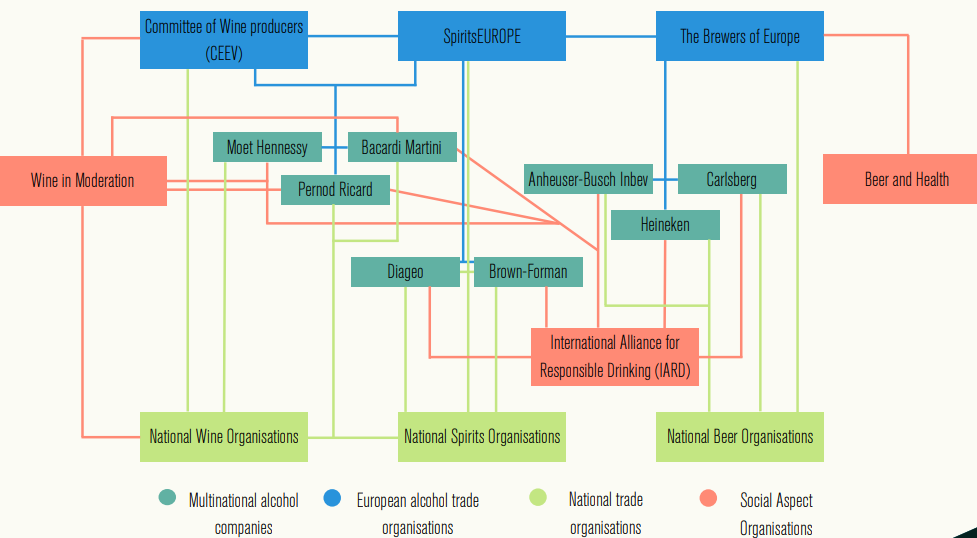
A 2022 report by Movendi International maps the actors and practices of the alcohol industry in the European sphere. The report aims to describe who they are, what their lobbying looks like in numbers, and how they operate.
The report found that the EU Commission held 270 meetings with the alcohol industry between 2014 and 2022, compared to 14 meetings with civil society organisations. This means that of all the meetings held regarding direct alcohol issues, 95% represented economic interests while 5% represented public health interests.
The report also stated that the alcohol industry estimated themselves to spend around €9 million on EU lobbying every year.
Below: Diagram on how the alcohol industry in the EU is organised and connected
Examples of the alcohol lobby's influence on EU decision makers
Alcohol is exempt from standard EU labelling requirements
The main EU food labelling legislation is Regulation (EU) No 1169/2011 on the provision of food information to consumers (the ‘FIC Regulation’), which requires certain mandatory information to be provided on the labels of prepackaged foods and drinks. This information includes the name of the food; net quantity; and the name and address of the company marketing the food. Additionally, consumers must be provided with a list of ingredients and a nutrition declaration, which includes the energy value as well as the amount of fat, carbohydrates, sugar, protein and salt.
The FIC Regulation exempts producers of alcoholic beverages containing more than 1.2 % by volume of alcohol from the obligation to provide a nutrition declaration and a mandatory list of ingredients. By contrast, this information must be included on the packaging of low-alcohol drinks.
In 2017, the European Commission published a report addressing whether alcoholic beverages should be covered by FIC Regulation in the future, as well as the reasons justifying possible exemptions. The report concluded that there were no objective grounds that would justify the absence of such information.
The European Commission promised to release a proposal for an EU mandatory alcohol labelling (with nutritional and ingredient information on label like all other food and drink products sold to consumers) by the end of 2022. The proposal is yet to be released. (July 2026)
The current EU labelling requirements for the industry is self-regulated, which has led to inadequate and wildly different results, with no one living up to the same demands as the requirements existing on non-alcoholic beverages.
EU’s Beating Cancer Plan
Europe’s Beating Cancer Plan, and the following BECA report in the European Parliament were initially groundbreaking initiatives on European alcohol policy. For the first time, a clear encompassing mandate had been given to prioritise health policy and to adopt EU legislation to prevent alcohol consumption as a key cancer risk factor.
While the channels of the industry are many, two were especially relevant in undermining the BECA report in the European Parliament – the European Parliament Beer Club and the Intergroup on Wine, Spirits, and Quality Foodstuff. These informal groups provide industry actors with direct access to Members of the European Parliament (MEPs), shaping legislative debates and decision-making.
Tactical Interventions in Policy Development
- Influencing the BECA Report: The BECA (Beating Cancer) Committee of the European Parliament initially aligned with public health advocates, supporting proven measures to reduce alcohol-related harm, such as health warnings and tighter restrictions on alcohol marketing. However, industry lobbying resulted in significant amendments:
- The phrase “no safe level of alcohol consumption” with the phrase “the safest alcohol consumption is none”. A small change, but that indicates a false claim that there are other safe levels.
- Health warnings were reframed as “responsible drinking” information.
- Proposals for a ban on alcohol sponsorship in sports were watered down to target only events predominantly attended by minors. An intervention that has been proven to be both difficult to implement and ineffective.
These changes were achieved through lobbying of Members of the European Parliament (MEPs), mainly through the European Parliament Beer Club and the Intergroup on Wine, Spirits, and Quality Foodstuff. Leading MEPs from both groups were the parliamentarians who tabled the amendments for the vote.
- Stalling Agricultural Promotion Reforms: The cancer plan proposed a review of the EU’s agricultural promotion programmes, which heavily subsidize wine and other alcoholic products. Industry groups, particularly those representing wine producers in France and Italy, argued that removing alcohol from these programmes would harm rural economies and erode cultural heritage. This review has since stalled and remains incomplete.
- Delaying Labelling Requirements: Proposals to mandate clear, on-package ingredient and nutritional labelling for alcoholic beverages faced pushback, with the industry advocating for digital labelling alternatives. While public consultations have occurred, implementation has been delayed.
Eurocare: Is the EU facilitating an industrial epidemic?
In 2023, the European Alcohol Health Policy Alliance (Eurocare) sent an open letter, signed by 68 leading civil society organisations, to the President of the European Commission, asking the European Commission to release the alcohol labelling proposal as soon as possible, to stop being influenced by economic operators and to stand up to EU citizens’ right to basic alcohol health information.
There is no harmonising EU legislation on the use of health warnings on alcohol beverage
The current EU framework legislation on labelling provides an exemption to alcoholic drinks from having to include ingredients and nutritional information on the packaging. The original framework food labelling directive initially provided no requirements relating to a need to indicate alcoholic strength, nor to list ingredients used in production.
The most comprehensive set of laws and regulatory requirements is set out in Regulation 1169/2011, which is directly applicable in Irish law. The Regulation holds two key exemptions for alcoholic beverages: they do not need to carry a list of ingredients, and they are exempt from all nutrition labelling requirements.
Under Article 16(4) of 1169/2011:
‘By 13 December 2014, the Commission shall produce a report concerning the application of Art 18 and Article 30(1) … addressing whether alcohol beverages should in future be covered.’
The 2014 Report recommended that standardised guidelines were now necessary, and that regulation may be more effective than voluntary agreements.
The 2017 Report concluded that while current voluntary initiatives are being developed and implemented by industry, it invited industry to present within a year (March 2018) a self-regulatory proposal that would cover the entire sector of alcoholic beverages. If the Commission considered an approach proposed as unsatisfactory, it would launch an Impact Assessment to review further mandatory harmonised options.
On 12 March 2018, the European associations representing the alcoholic beverages sectors presented their self-regulatory proposal to the Commission. The proposed self-regulation contains a common commitment applying to the wine, cider, spirit and beer sectors, and is accompanied and complemented by sectoral annexes laying detailing the process and modalities for its implementation. Specifically, it determines a separate approach to each sector: wine, spirits, beer, etc., and the exclusive use of off-labelling presentation via a variety of online methods only: QR Code, a bar code or through other direct means using smart technologies.
Eurocare – European Alcohol Policy Alliance response to this development is available here: ‘We deserve better – reaction to alcohol industry self-regulatory proposal for labelling’.
There is now a proposal to revise the Regulation on Food Information to Consumers to provide for nutritional information on alcohol products with a number of consultations being carried out and an Impact Assessment in the period 2020-2022. AAI has contributed to this consultation process. More details on the process here.
The 2021 European Commission’s action plan ‘Europe’s Beating Cancer Plan’ outlines a ‘political commitment to leave no stone unturned to take action against cancer’ and under the proposed prevention actions: ‘Saving lives through sustainable cancer prevention’, it outlines the need to ‘give people the information and tools they need to make healthier choices’ and in recognizing that ‘Alcohol-related harm is a major public health concern in the EU.
In 2016, cancer was the leading cause of alcohol-attributable deaths with a share of 29%, followed by liver cirrhosis (20%), cardiovascular diseases (19%) and injuries (18%)’ it proposes: ‘the Commission will review its promotion policy on alcoholic beverages and in addition propose a mandatory indication of the list of ingredients and the nutrition declaration on alcoholic beverage labels before the end of 2022 and of health warnings on labels before the end 2023.
Ireland
The Public Health (Alcohol) Act 2018 (PHAA) makes provision for the provision of health information labeling on alcohol products. In June 2022 Irish government notified the European Commission of Draft Regulations under Section 12 of the Public Health (Alcohol) Act 2018. This significant progress comes over 1,300 days since the legislation was enacted by the Irish parliament.
These regulations essentially establish the modalities of how the law will be applied on all alcohol products and how the information prescribed will be presented to the consumer in an On-Trade environment. The principal points of information to be convened on-product are:
- A warning to inform people of the danger of alcohol consumption.
- A warning to inform people of the danger of alcohol consumption when pregnant.
- A warning to inform people of the direct link between alcohol and fatal cancers.
- The quantity of grams of alcohol contained in the product.
- The number of calories contained in the alcohol product.
- A link to a health service website which gives information on alcohol and related harms.
The submission of the Draft Regulations to the European Commission triggers a period of a procedure that allows the Commission and the Member States of the EU to examine the technical regulations Member States intend to introduce for products (industrial, agricultural and fishery) and for Information Society services before their adoption, as well as allowing all stakeholders an opportunity to make their voices heard.
Alcohol Action Ireland led a campaign to encourage public health advocates to make supportive submissions to the process. 60 such submissions were made representing almost 70% of all submissions. 13 Member States issued detailed opinions or comments. The European Commission considered its position until 22 December 2022. No comment was issued by the Commission.
This is entirely consistent with the EU’s 2011 regulation on the provision of food information to consumers which provides that Members States can also adopt national labelling measures provided they notify the European Commission and other member states in advance. This is a recognition of a Member State’s competency to adopt measures requiring mandatory particulars to on-product alcohol labelling on grounds of the protection of public health.
Stella Kyriakides European Commissioner for Health and Food Safety in a response on 14 March 2023 to a Parliamentary Question on the regulations noted: “In the context of the analysis under the FIC Regulation, the Commission considered that the Irish authorities demonstrated that the notified measures were justified on public health grounds considering the situation in Ireland and that any resulting restrictions for the internal market that the measures may have were proportionate to the objective pursued……. Having analysed exclusively the draft measures notified in 2022, the Commission decided not to issue a reaction under the SMTD.”
https://www.europarl.europa.eu/doceo/document/E-9-2023-000108-ASW_EN.pdf
In February 2023, the Irish Government notified the World Trade Organisation of its intention to proceed with Ireland’s labelling regulations.
AAI also welcome moves in the EU to revise the Regulation on Food Information to Consumers to provide for nutritional information on alcohol products. In addition we warmly endorse the EU Beating Cancer plan with its proposal to have health warning labels before the end of 2023. Ireland’s PHAA labelling regulations are in keeping with these proposals.
Given the high levels of alcohol harm in Ireland as outlined in our submission to the EU process it is essential that there is no further delay in progressing their implementation.