Alcohol Action Ireland press release, Friday, 8 May 2026
Alcohol Action Ireland (AAI), the national independent advocate to reduce alcohol harm, welcomes the publication of 2025 Revenue data which indicates a 2% decrease in per capita alcohol consumption in Ireland compared to 2024, from 9.43 to 9.24 litres of pure alcohol a year per person aged 15 and over. This is still stubbornly above the modest government target of 9.1 litres per capita which was set in 2013, to be achieved by 2020.
However, per capita figures include the 29% of people in Ireland who don’t drink and some important realities are hidden in the data. When adjusted to look at consumption per drinker aged 15 and over, the data actually shows an increase in consumption, from 12.92 to 13.02 litres of pure alcohol per drinker, indicating that people who do drink are drinking more and in a more hazardous manner, which is a perfect storm for alcohol harms.
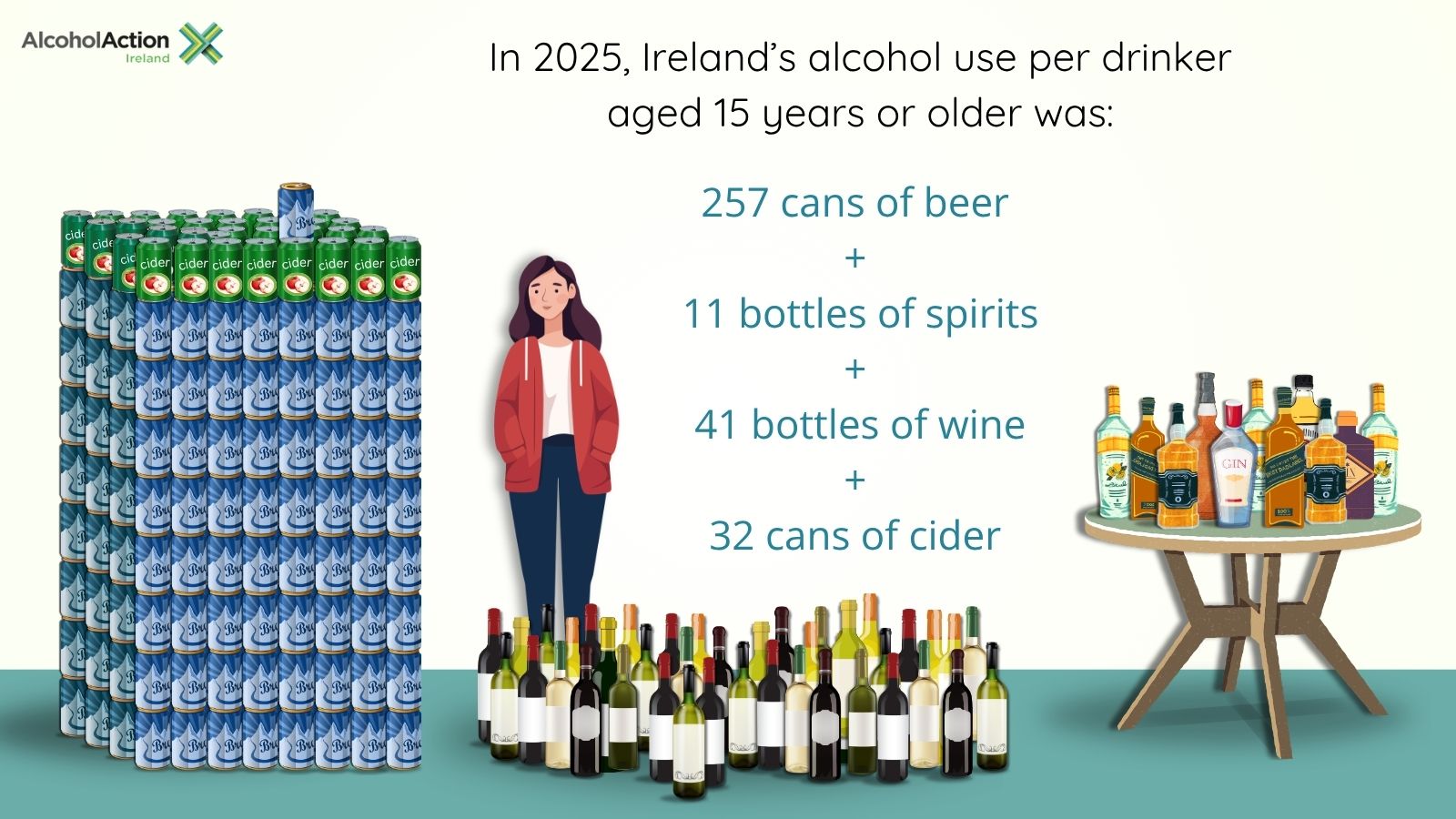
AAI CEO Dr Sheila Gilheany said: “While we welcome the reduction in consumption per capita, we get a very different picture when we look at the per drinker data which is more relevant for harms analysis. This data equates to every drinker aged 15 and over in Ireland drinking on average 257 cans of beer, 11 bottles of spirits, 41 bottles of wine and 32 cans of cider a year.
“Hazardous drinking is normalised in Ireland. In fact, Ireland has the second highest level of binge drinking across the OECD, with the Health Research Board (HRB) reporting that binge drinking among low- to moderate-risk drinkers accounts for most alcohol-related harm in Ireland.
“One of the main areas of concern is the increase in young people’s drinking. Youth drinking in Ireland has surged over the past decade, from 66% in 2016 to 78% in 2025, and we now have a situation where young drinkers aged 15–24 make up the largest proportion of the population consuming alcohol – 78% – significantly higher than the national average (71%). Worryingly, 64% of this cohort regularly binge drink. The recent Growing Up in Ireland study reported that more than two fifths of 25-year-old Irish men and a third of 25-year-old women drink to what the World Health Organization (WHO) considers to be hazardous levels.”
The groundbreaking Public Health (Alcohol) Act (2018) (PHAA) aims to reduce population-level alcohol consumption and to minimise the amount of alcohol marketing children and young people are exposed to. However, its implementation has been slow and against a backdrop of industry interference it has lacked strategic planning so its public health benefits have yet to be fully realised.
Dr Gilheany continued: “The alcohol industry will no doubt trumpet this per capita data to say that alcohol is no longer a problem in Ireland and that we should loosen regulations. This is nonsense. Ireland is still drinking more than a third above the current HSE lower-risk guidelines with significant health impacts as well as those on crime, social care, road safety and workplace productivity.
“Unfortunately, there is no coherent cross-government strategy to tackle alcohol harms and alcohol policy in Ireland is in a state of drift with the current government. Health labelling legislation, which was passed in 2018, was due to come into force this month but has been delayed until September 2028 after intense industry lobbying. Excise duties have not been increased since 2014 so their public health value continues to be eroded by inflation and are now at least 15% lower in real terms, while Minimum Unit Pricing has never been increased and is still at the same level that was first proposed at back in 2013.
“Important sections of the PHAA regarding advertising have yet to be commenced and many of the rules that are in force are being circumvented by the loophole of marketing zero-alcohol products that use the same branding as the master brand. In addition there are serious issues in relation to children’s exposure to online alcohol marketing which is not covered by the PHAA.
“There is, however, an opportunity to address concerns in the upcoming new strategy from Healthy Ireland. There must be a recognition that alcohol policy should be coherent across government. It is not enough to expect that improvements in relation to alcohol can only be delivered by the Department of Health. Healthy Ireland aims to place prevention, equity and a whole‑of‑government approach at the centre of public policy.
“If government really wants to achieve a level of alcohol reduction that will improve public health, reduce injuries and deaths, and save the health system and taxpayer money, then all sections of the PHAA must be made operational in tandem, and any loopholes closed as a matter of urgency. Critically government must act together against industry interference to address Ireland’s largest drug problem.”
ENDS

