
What is Foetal Alcohol Spectrum Disorder (FASD)?
Foetal Alcohol Spectrum Disorders (FASD) are a group of disorders caused by prenatal alcohol exposure and are associated with a range of lifelong physical, mental, learning/educational, social, and behavioural difficulties.[i] FASD comprise Foetal Alcohol Syndrome (FAS), partial Foetal Alcohol Syndrome, Alcohol Related Birth Defects, and DSM-5 Neurodevelopmental Disorder – Prenatal alcohol exposure.[ii] The symptoms of FASD may vary from child to child but are lifelong.[iii]
FASD is often an invisible disability, yet prenatal alcohol exposure is the leading preventable cause of neurodevelopmental disorder. According to the HSE, only a small proportion of children with FASD have visible facial features (facial dysmorphia), with the majority of children with FASD having no visible signs of disability at birth.[iv] Indeed, difficulties due to FASD may not manifest until preschool or school age.
Shockingly, there are no standard diagnostic policies or guidelines for diagnosing or treating children with FASD in Ireland. There is no national strategy for the prevention of FASD or for the response to children and adults with FASD.
There are, however, a number of policies and strategies that include actions to reduce alcohol use in pregnancy and prevent FASD.[v] Unfortunately, one such policy – alcohol health information labelling – has been delayed two years, until 2028, due to lobbying from the alcohol industry and acquiescence from government.
What Causes Foetal Alcohol Spectrum Disorders?
FASD is caused by the consumption of any amount of alcohol at any time from 6 weeks before conception (either parent) and for the duration of the pregnancy.
Alcohol is a teratogen, a substance that negatively affects the embryo and foetus during pregnancy.[vi] Resultantly, FASD is caused by prenatal alcohol exposure and is associated with a range of lifelong physical, mental, educational, social, and behavioural difficulties. Therefore, no amount of alcohol is safe when planning to conceive or during pregnancy.[vii]
Alcohol has an adverse effect on the developing brain, and on body organs, and the greater the amount of alcohol that has been consumed during pregnancy, the greater the risk to the development of the embryo and foetus.
As Dr Mary T O’Mahoney, a public health consultant and fellow of the Royal College of Physicians of Ireland (RCPI), has stated – “No amount of alcohol at any stage of pregnancy is safe for your baby.”.[viii] While the World Health Organization (WHO) has called for action on the prevention of alcohol use in pregnancy and the prevention of FASD in its Global Action Plan on Alcohol.
Paternal Alcohol Consumption
A father’s alcohol consumption has long been overshadowed by the focus on what a mother drinks.[ix] However, people may not realise that paternal alcohol consumption prior to pregnancy can increase the likelihood of FASD.[x] This is of particular concern as men drink more, are more likely to binge drink, are more likely to develop alcohol use disorder than women.[xi]
Historically, research on fertility and reproduction has been female focused with little attention or examination on the male side.[xii] However, there is a growing body of research into the role of paternal alcohol consumption pre-pregnancy, with several studies pointing to the role a father’s drinking prior to conception plays in the development of FASD.[xiii]
Maternal Alcohol Consumption
As previously outlined, alcohol use can result in harm not only to the drinker, but also to other individuals associated with the drinker.[xiv] A classic example of this harm to others is the harm caused by consuming alcohol during pregnancy.
Alcohol is a teratogen, a substance that negatively affects an embryo and foetus during pregnancy, that can readily cross the placenta, resulting in damage to the brain and other organs of the developing embryo and foetus.[xv] Therefore, it is crucial for the public to know that there is no evidence-based, defined, safe amount of alcohol that can be consumed during pregnancy to prevent a child being born with FASD.[xvi]
How Common are Foetal Alcohol Spectrum Disorders?
International studies confirm that the higher the alcohol consumption in a country, the higher the rates of FASD.[xvii] This association between prenatal alcohol exposure and FASD is strong and consistent from study to study, in all countries, nationalities, ethnic and socio-economic groups.[xviii]
Unfortunately, an estimated 10% of pregnancies globally are exposed to alcohol.[xix] In Ireland, the figure is considerably higher with four in five of first pregnancies are exposed to alcohol and nearly one in two (45%) exposed at high-risk levels.[xx] A comprehensive study, carried out in Ireland, Australia, the UK and New Zealand (2017), found that Ireland emerged as the country with the highest rates of drinking, both before (90%) and during (82%) pregnancy, and of binge drinking, before (59%) and during (45%) pregnancy.
Tragically, but unsurprisingly, with such high levels of alcohol consumption during pregnancy Ireland has the third highest level of FASD in the world, possibly affecting up to 7.4% of the population as highlighted by the HSE.[xxi] The best available evidence estimates that about 600 Irish babies are born each year with Foetal Alcohol Syndrome (FAS), with a further 9-10 times this number of babies born annually who have other Foetal Alcohol Spectrum Disorders.[xxii]
This compares against an estimated global prevalence rate of 0.8%,[xxiii] while the WHO European Region had the highest prevalence at 19.8 per 1000 population.[xxiv] The higher rate for Europe, as with Ireland, is unsurprising given Europe is the area with the highest alcohol consumption per capita globally.[xxv]
However, there is some good news as 2026 research by the UCD Perinatal Research Centre at the National Maternity Hospital found that most pregnant women in Ireland avoid alcohol.
Preventing Foetal Alcohol Spectrum Disorders
FASD is preventable through avoiding alcohol before conception and during pregnancy. However, this requires the efforts of government and the HSE at a national level.
Central to preventing FASD is a whole of government strategy to drive evidence-based measures that lead to a reduction in FASD and to drive appropriate assessment and intervention strategies when the diagnosis is suspected or made.[xxvi] Shamefully, there is no such national strategy in Ireland for the prevention of FASD or for the response to children and adults with FASD.
The most effective measure to achieve a reduction in the incidence of FASD is to reduce the population’s alcohol per capita consumption, and the foremost way to achieve this is to apply the WHOs ‘Best Buys’ on alcohol.[xxvii] These are controls on price, advertising/marketing, and availability of alcohol. Such interventions are the most effective public policy measures that governments can take to offset at least some of the harm, such as FASD, caused by alcohol.
In addition, communications campaigns, routine screening and brief interventions by healthcare professionals, healthcare supports for pregnant women, training and professional development supports for staff, and research and public health surveillance, as well as timely diagnosis and treatment for children with FASD is required.
A final core preventive measure is pregnancy warning labels on alcohol products to inform the public of the dangers of alcohol when pregnant. This is exactly what Ireland’s alcohol health information labelling intends to do. Unfortunately, these warning labels have delayed two years, until 2028, due to lobbying from the alcohol industry and acquiescence from government.
It is unconscionable, but unsurprising, that Big Alcohol opposes health information labelling aimed at informing the public of the risks related to alcohol and pregnancy. The industry simply does not want people to know that there is no amount of alcohol that’s known to be safe to drink during pregnancy, and if you drink during pregnancy, you place your baby at risk of FASD.[xxviii]
It is essential that women are supported to have an alcohol-free pregnancy, and that the health service provides people with consistent advice about alcohol use in pregnancy. While FASD is entirely preventable, if alcohol is avoided in pregnancy, we need to acknowledge that some women will need additional supports to abstain, and they should be supported to access these.[xxix]
Supporting those with Foetal Alcohol Spectrum Disorder
Disgracefully, there is no national strategy or model of care for children and adults with FASD. As a result, many do not receive the care and support they need.
Therefore, it is essential that the Department of Health and the HSE develop a model of care and statutory guidelines for FASD. As part of the model of care there is a need for the State to adopt the International Classification of Function, a validated tool for standard needs assessment, and provide interventions and supports to children and adults with FASD.
The development and roll out of supports for those with FASD must also be done in a regionally balanced manner so that they exist in every part of the State. Furthermore, it is essential that supports provide for adults and people when they reach 18 years old.
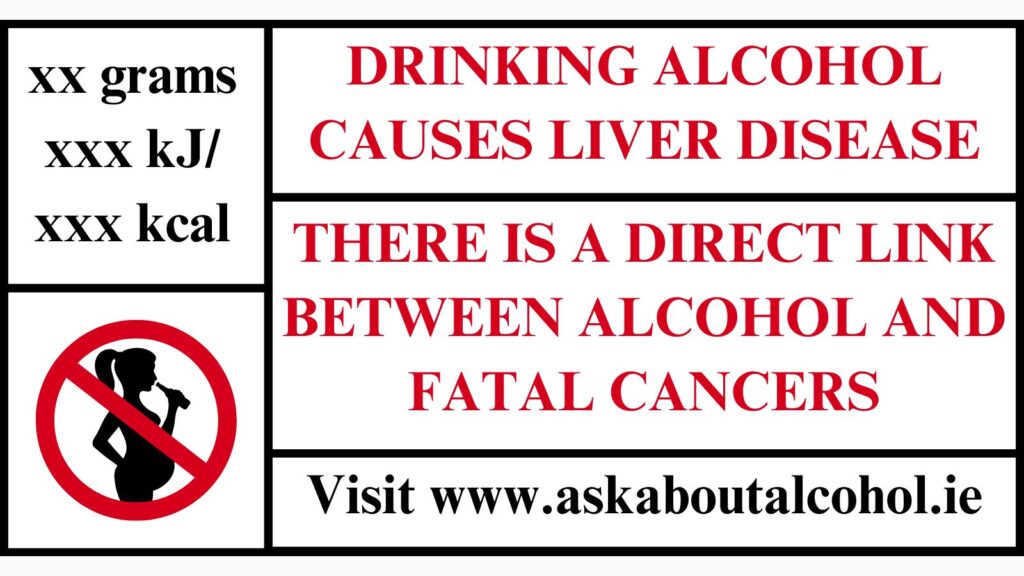
The importance of alcohol health information labelling
Alcohol health information labelling is central to informing the public of the dangers of alcohol consumption when pregnant and is strongly recommended by healthcare and medica. Professionals. Unsurprisingly, the alcohol industry does not want the public to know this and have fought tooth and nail against the introduction of alcohol labelling.
Attempts to derail labelling of alcohol products is nothing new. The alcohol industry opposed the introduction of mandatory, visible pregnancy warning labelling regulations in Australia and New Zealand for over 20 years.[xxx] These were finally passed in 2020, coming into effect in August 2023. Even now there is a distinct issue with non-compliance with the regulations with studies indicating that only 63% of products are displaying the label despite a generous 3-year lead in period.[xxxi]
It is now seven years since the Public Health (Alcohol) Act legislated for pregnancy warnings on alcohol products, and the timeline for introducing labels has been delayed by two years from 2026 to 2028. That is a decade of people not being made aware of the dangers of alcohol during pregnancy. It is imperative that labelling goes ahead in 2028 and that there are no more delays.
Alcohol health information labelling is essential for empowering people to make an informed decisions in relation to alcohol and their health. The label warning of the dangers of alcohol consumption when pregnant can give people the information they need to make the decision not to drink when pregnant, thereby reducing incidences of FASD in Ireland. There can be no deviation from the timeline for its introduction.
Download the HSE’s Pregnancy and Alcohol leaflet here
[i] https://www.hse.ie/eng/about/who/healthwellbeing/our-priority-programmes/alcohol-programme/hse-position-on-prevention-of-fasd.pdf
[ii] https://www.hse.ie/eng/about/who/healthwellbeing/our-priority-programmes/alcohol-programme/hse-position-on-prevention-of-fasd.pdf
[iii] https://www.mayoclinic.org/diseases-conditions/foetal-alcohol-syndrome/symptoms-causes/syc-20352901#:~:text=Issues%20with%20behavior%20and%20with,Quickly%20changing%20moods.
[iv] https://www.hse.ie/eng/about/who/healthwellbeing/our-priority-programmes/alcohol-programme/hse-position-on-prevention-of-fasd.pdf
[v] https://www.hse.ie/eng/about/who/healthwellbeing/our-priority-programmes/alcohol-programme/hse-position-on-prevention-of-fasd.pdf
[vi] https://www.thelancet.com/journals/langlo/article/PIIS2214-109X(17)30021-9/fulltext
[vii] https://www.fasdireland.ie/What
[viii] https://www.thetimes.com/world/ireland-world/article/our-secret-shame-so-many-babies-affected-by-mothers-drinking-hrmxbxnfl
[ix] https://www.bbc.com/future/article/20240801-foetal-alcohol-syndrome-the-overlooked-risk-of-fathers-who-drink
[x] https://pubmed.ncbi.nlm.nih.gov/38226752/
[xi] https://www.scientificamerican.com/article/fathers-drinking-may-be-linked-to-foetal-alcohol-syndrome/
[xii] https://www.bbc.com/future/article/20240801-foetal-alcohol-syndrome-the-overlooked-risk-of-fathers-who-drink
[xiii] https://www.bbc.com/future/article/20240801-foetal-alcohol-syndrome-the-overlooked-risk-of-fathers-who-drink
[xiv] https://www.thelancet.com/journals/langlo/article/PIIS2214-109X(17)30021-9/fulltext
[xv] https://www.thelancet.com/journals/langlo/article/PIIS2214-109X(17)30021-9/fulltext
[xvi] https://www.hse.ie/eng/about/who/healthwellbeing/our-priority-programmes/alcohol-programme/hse-position-on-prevention-of-fasd.pdf
[xvii] https://pubmed.ncbi.nlm.nih.gov/28828483/
[xviii] https://www.hse.ie/eng/about/who/healthwellbeing/our-priority-programmes/alcohol-programme/hse-position-on-prevention-of-fasd.pdf
[xix] https://onlinelibrary.wiley.com/doi/10.1111/acer.14705
[xx] https://bmjopen.bmj.com/content/5/7/e006323
[xxi] https://www.hse.ie/eng/about/who/healthwellbeing/our-priority-programmes/alcohol-programme/hse-position-on-prevention-of-fasd.pdf
[xxii] https://www.hse.ie/eng/about/who/healthwellbeing/our-priority-programmes/alcohol-programme/hse-position-on-prevention-of-fasd.pdf
[xxiii] https://onlinelibrary.wiley.com/doi/10.1111/acer.14705
[xxiv] https://canfasd.ca/wp-content/uploads/2018/05/JAMA-Pediatrics.pdf
[xxv] https://www.drugsandalcohol.ie/39086/
[xxvi] https://www.hse.ie/eng/about/who/healthwellbeing/our-priority-programmes/alcohol-programme/hse-position-on-prevention-of-fasd.pdf
[xxvii] https://iris.who.int/bitstream/handle/10665/259232/WHO-NMH-NVI-17.9-eng.pdf?sequence=
[xxviii] https://www.mayoclinic.org/diseases-conditions/foetal-alcohol-syndrome/symptoms-causes/syc-20352901#:~:text=Issues%20with%20behavior%20and%20with,Quickly%20changing%20moods.
[xxix] https://about.hse.ie/news/alcohol-free-pregnancy-fetal-alcohol-spectrum-disorders-fasd/
[xxx]https://www.researchgate.net/publication/360202250_Influencing_and_implementing_mandatory_alcohol_pregnancy_warning_labels_in_Australia_and_New_Zealand
[xxxi] https://www.sciencedirect.com/science/article/pii/S1326020024000918?via=ihub