How does alcohol harm children?
Children in Ireland experience harm from alcohol in multiple ways, including:
- Exposure to alcohol during pregnancy (FASD)
- Being brought up in homes where there is problem alcohol use
- Exposure to risk on the streets from others who are engaged in alcohol use
- Being introduced to alcohol at an early age and being exposed to harmful marketing practices
Health
Alcohol use poses a serious risk to children and young people’s health and well-being, due largely to the fact that they are more vulnerable to the effects of alcohol than adults as their bodies and brains are still developing.
Ireland is estimated to have the third highest rate of drinking in pregnancy globally and with it one of the highest estimated rates of FASD with around 6000 babies born every year with this lifelong, entirely preventable condition which has serious impacts on the child’s development, education and life course. Read more about FASD here.
Research shows that the earlier a person starts drinking alcohol at harmful levels, the greater the risk of changing the development of the brain. This can lead to problems with memory and learning and increases the risk of having alcohol-related problems later in life.
A study found that Irish third level students who were regular, heavy drinkers were less likely to use positive coping strategies when feeling anxious or depressed. Although, in the short-term it may seem and feel like a good idea, alcohol can increase depression and anxiety soon after its use, leaving people feeling low and unable to cope.
A national study of youth mental health found strong links between excessive drinking and suicidal behaviour.
Key facts
- While drinking among young people aged 15–24 declined from the mid-2000s to the mid-2010s, since 2015 that downward trend has been reversing.
- Alcohol consumption levels for young people aged 15-24 increased from 66% in 2018 to 78% in 2025.
- The decline in consumption since the highs of the 2000s was driven by younger adolescents, particularly those under 17 – who should not be drinking anyway.
- Every year approximately 50,000 children start drinking in Ireland. Starting to drink alcohol as a child, which is the norm rather than the exception in Ireland, is a known risk factor for later dependency.
- Hazardous drinking, including binge drinking, is commonplace (64%) among young people and one in three young drinkers has an Alcohol Use Disorder.
- In 2019 young people in Ireland were, on average, 16.6 years old when they have their first alcoholic drink. In 2002 that number was 15.6 years.
- While young people are delaying alcohol initiation, once they begin drinking they consume alcohol above the national average (75% vs 73%).
- In 2016, 16% of all deaths in Europe among 15- to 19-year-olds were attributable to alcohol, while for 20- to 24-year-olds, this figure was 23%.
Recommendations
- A bold new approach is needed if we are to see more than superficial change in youth drinking. At a minimum the Public Health (Alcohol) Act 2018 must be implemented in full – including the rollout of alcohol health information labelling from its delayed date of 2028.
- Minimum Unit Pricing must be uprated in line with the Consumer Price Index so as to maintain its public health value.
- The lacuna in the law which allows advertising of zero-alcohol products, using the identical branding of the master brand alcohol product, must be closed.
- A new target to reduce alcohol consumption to within the HSE lower-risk drinking guidelines should be set – 6.1 litres per capita.
- There needs to be coherent policy across government with, for example, increases in excise duties annually in line with inflation, no increases in licensing hours and venues, addressing online marketing to children, plus enforcement of existing legislation on drink driving and the serving of alcohol to minors and those intoxicated.
Drinking behaviour in young people
Every year in Ireland, approximately 50,000 children in Ireland start drinking. This can pose a serious risk to their health and well-being as alcohol is an age-restricted, toxic substance associated with a range of health conditions, diseases and injuries.
Starting to drink alcohol as a child, which is the norm rather than the exception in Ireland, is more likely to lead to heavy episodic drinking and is a known risk factor for later dependency.
There are a number of sources of data in relation to youth drinking in Ireland. While these use different methodologies and are not always directly comparable, they consistently show concerning patterns of youth drinking in Ireland.
Data sources
Since 2014 the Department of Health has carried out an annual survey – Healthy Ireland. This indicates that youth drinking in the age group 15-25 years has steadily increased from 66% in 2016 to 78% in 2025. In the same period, alcohol consumption in the population over the age of 15 years has decreased from 75% in 20216 to 71% in 2025.
In Ireland, data from the Health Behaviours in Ireland survey of young people aged 9-18 years indicated that alcohol use appeared to have been declining since the mid-2000s. However, an in-depth research paper carried out by the HRB into youth drinking concluded that when smaller age groups are examined, it appears that this overall decline is being driven by younger adolescents, particularly those less than 17 years.
While it is indisputable that young people are delaying alcohol initiation, what appears to be happening is that once they do start drinking (on average at 16.6 years), hazardous drinking, including binge drinking, is commonplace. The study notes: it is important that public health actors do not get complacent and continue to pursue best practices when it comes to delaying and preventing alcohol use among young people.
Interpreting data from the Health Behaviours in School Aged Children study suggests that every year 50,000 children in Ireland start drinking.
Further evidence about youth drinking in Ireland can be found in the Planet Youth surveys from the west of Ireland, the My World survey and the Growing up in Ireland study. There is also data available from the Central Statistics Office Irish Health Survey. International comparisons can be found from the 2024 European School Survey Project on Alcohol and Other Drugs (ESPAD) which can be accessed here.
2025 data from Planet Youth in Galway, Roscommon and Mayo on trends over the past 6 years shows that three quarters of 15-16 year olds have tried alcohol; half have been drunk in their lifetime; a third have been drunk in the past month; while a quarter of them are drinking in pubs. See here and here for Planet Youth data.
The My World Survey was developed by University College Dublin (UCD) and Jigsaw, the National Centre for Youth Mental Health. It is a comprehensive study of young people’s mental health. Growing up in Ireland is a national, longitudinal study of children and young people in Ireland and is a collaborative programme of work between the CSO and the Department for Children, Equality, Disability, Inclusion, and Youth (DCEDIY).
A 2020 report from the HRB on data from My World and Growing Up in Ireland surveys found that, in 2019, 89% had consumed alcohol by the age of 17/18 and that by 20 that figure increased to 96%, with 93% reporting that they currently drink alcohol. The most recent analysis of the Growing up In Ireland survey published in 2025 found that just over two in five of this group at age 20 reported levels of drinking that could be categorised as risky or hazardous. At age 25, this figure had decreased slightly to just under two in five (39%) of respondents who reported a level of drinking that could be considered risky or hazardous compared with 40.1% of respondents who recorded a non-hazardous level of drinking.
The CSO Irish Health Survey was carried out in 2019, 2024 and 2025 and asked a number of questions relating to alcohol. In 2019 it found that 76% of the population over 15 years were drinking and that 67% of 15-24 years were drinking. In 2025 the survey found that 77% of the population over 15 years were drinking while in the age group 15-24 years this figure was 68%. The 2024 survey did not include under 18s.
According to the World Health Organisation, Europe is the highest drinking region in the world. The 2024 European School Survey Project on Alcohol and Other Drugs (ESPAD) found that lifetime alcohol use amongst 15- to 16-year-olds in Ireland dropped from 91% in 1995, to 72% in 2019 and to 67% in 2024. This compares favourably with EU averages especially after the introduction of the Public Health (Alcohol) Act 2018 and indicates the importance of public health measures to address alcohol issues.
More details on alcohol and young people is available in the Alcohol Action Ireland report here.

Marketing
Alcohol is one of the most heavily marketed products with the annual spend on alcohol marketing conservatively estimated at €115m in Ireland alone. That’s why the role of alcohol marketing in encouraging, normalising and glamourising alcohol consumption among young people cannot be underestimated as a contributing factor to high levels of drinking. The international literature is clear – the greater the level of exposure to, or engagement with, alcohol marketing, the more likely young people are to drink alcohol.
Read more here about alcohol marketing and young people
Growing up with problem alcohol use in the home
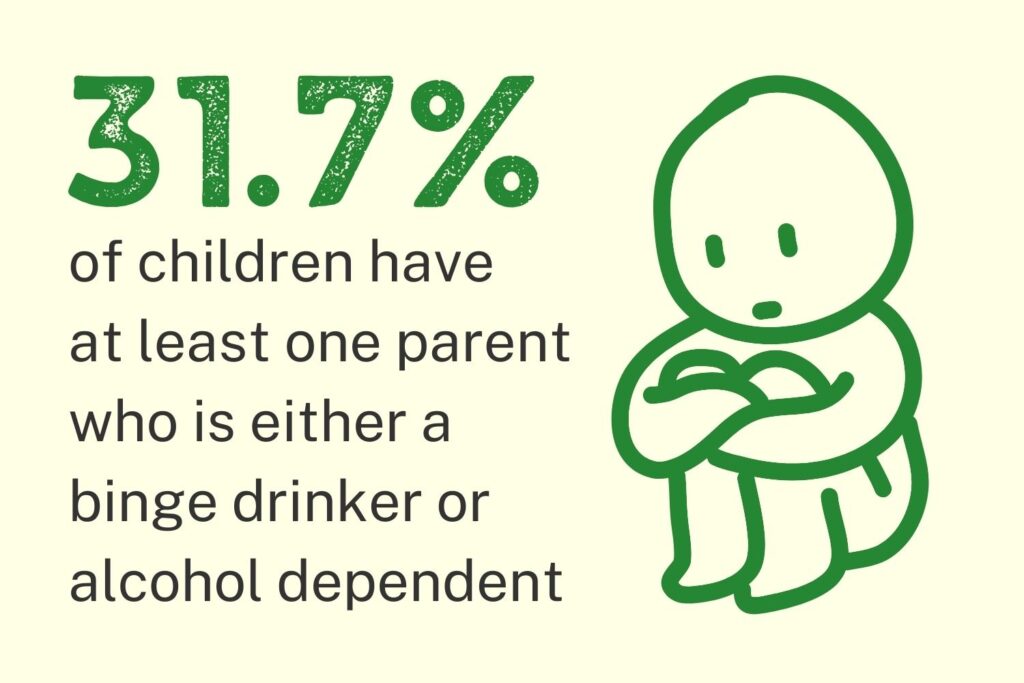
Growing up in a home with parental problem alcohol use has been recognised internationally as an adverse childhood experience for over 20 years, and the physical and mental consequences of this issue have also been studied.
In Ireland, at least 1 in 6 young people suffer the unnecessary impact of alcohol-related harms at home. Therefore, it is likely that today more than 200,000 children in Ireland are living with the traumatic circumstances of a childhood where parental problem alcohol use (PPAU) is a frequent event. It is further estimated that there are around 1,000,000 in Ireland today who are adult children from alcohol-impacted families. This means that approximately 1.2 million people across all age ranges in Ireland may be suffering because of the impact of alcohol harm in their family.
Silent Voices, an initiative of Alcohol Action Ireland, seeks to highlight the harm caused by PPAU and its impact across the lifespan.
Read more about the Silent Voices campaign here
Alcohol and children FAQs
Older people are more susceptible to the effects of alcohol due to their body’s decreasing ability to break it down. Below are answers to common questions about alcohol and its impact on older people.
How can alcohol harm children?
Alcohol can harm children both directly and indirectly. Harm can occur through exposure to alcohol during pregnancy, growing up in a home affected by problem alcohol use, exposure to alcohol-related risks in public spaces, early alcohol use, and exposure to alcohol marketing. These experiences can affect children’s physical health, mental wellbeing, development, and future relationship with alcohol.
Why are children and teenagers more vulnerable to alcohol than adults?
Children and teenagers are more vulnerable to alcohol because their brains and bodies are still developing. Research shows that drinking at a young age can affect brain development, memory, learning, emotional regulation, and decision-making. Early alcohol use is also linked to an increased risk of alcohol-related problems later in life.
What is the impact of drinking alcohol during pregnancy?
Alcohol use during pregnancy can cause Foetal Alcohol Spectrum Disorders (FASD), a lifelong condition that affects physical, cognitive, behavioural, and social development. FASD is entirely preventable by avoiding alcohol during pregnancy. Ireland is estimated to have one of the highest rates of FASD in the world.
What is Foetal Alcohol Spectrum Disorder (FASD)?
Foetal Alcohol Spectrum Disorder (FASD) is a group of conditions caused by prenatal exposure to alcohol. Children with FASD may experience lifelong challenges affecting learning, memory, behaviour, communication, and physical health. The severity and symptoms can vary from person to person.
Does starting to drink alcohol at a young age increase future risks?
Yes. Research shows that people who begin drinking alcohol during childhood or adolescence are more likely to engage in hazardous drinking, binge drinking, and develop alcohol dependency later in life. Delaying the age at which young people start drinking reduces these risks.
How common is underage drinking in Ireland?
Underage drinking remains a significant public health issue in Ireland. Approximately 50,000 children start drinking alcohol each year. While some young people are delaying their first drink, hazardous drinking and binge drinking remain common among those who do consume alcohol.
What are the mental health risks of alcohol use among young people?
Alcohol use among young people is associated with increased anxiety, depression, poor coping strategies, and a higher risk of suicidal behaviour. Although alcohol may seem to provide temporary relief from stress or emotional difficulties, it can worsen mental health problems over time.
How does alcohol marketing influence children and young people?
Research consistently shows that the more children and young people are exposed to alcohol marketing, the more likely they are to start drinking and to drink more heavily. Alcohol marketing can normalise and glamourise drinking, making it appear attractive and socially acceptable to young audiences.
What is parental problem alcohol use and how does it affect children?
Parental problem alcohol use occurs when a parent’s drinking negatively affects family life and child wellbeing. Children growing up in these environments may experience emotional distress, trauma, instability, and long-term mental and physical health consequences. It is recognised internationally as an adverse childhood experience (ACE).
How many children in Ireland are affected by parental alcohol problems?
It is estimated that at least one in six young people in Ireland are affected by parental problem alcohol use. This means that more than 200,000 children may currently be living with alcohol-related harm in the home.
Is binge drinking common among young people in Ireland?
Yes. Hazardous drinking, including binge drinking, remains common among young people in Ireland. Research indicates that many young drinkers consume alcohol at levels above the national average once they begin drinking, despite some progress in delaying alcohol initiation.
What can be done to reduce alcohol-related harm among children and young people?
Reducing alcohol-related harm requires a combination of evidence-based policies, including restricting alcohol marketing to children, fully implementing public health legislation, supporting families affected by alcohol problems, maintaining effective pricing measures, and preventing underage access to alcohol. Protecting children from alcohol harm requires coordinated action across government and society.