Key facts
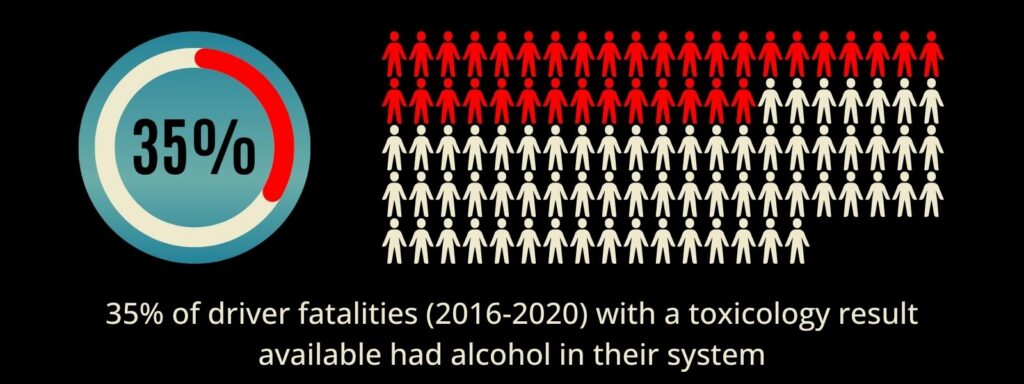
- Over a third (35%) of driver fatalities (2016-2020) with a toxicology result available had a positive toxicology for alcohol.
- Almost one in eight drivers (12%) admit to drink driving – that’s around 424,500 people a year, many of whom drink drive multiple times a year.
- Ireland has the lowest level of roadside breath testing in the EU
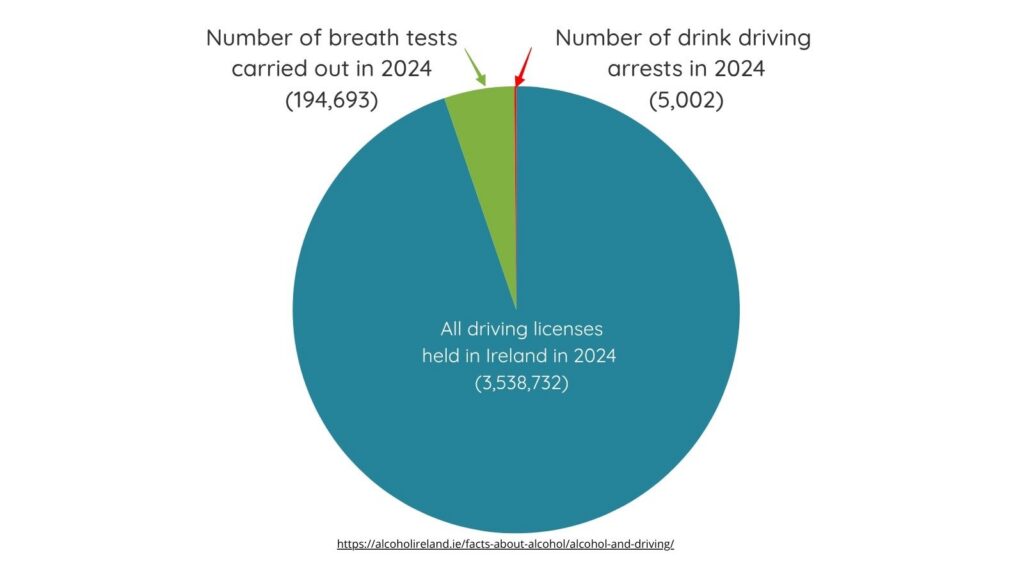
- Only 5,002 arrests for drink driving were made in 2024.
- There are cumbersome procedures around the collection of blood samples following collisions leading some offenders to evade detection.
- 37% of prosecutions for drink driving do not succeed in court.
Alcohol's impact on driving
Even in small amounts, alcohol impairs driving ability and as blood alcohol concentration (BAC) increases the functioning of vital processes for safe road use, such as vision and motor skills, becomes progressively more impaired. In short, any amount of alcohol increases the risk of involvement in a road traffic collision.
Alcohol has been shown to impair driving performance at blood alcohol concentrations as low as 0.02% [60,61] and well before the driver or observers are able to detect signs of intoxication [62]. Most countries maintain maximum legal blood alcohol concentration levels for non-probationary drivers (e.g., 0.05%, 0.08% [58]) that are higher than levels now known to significantly increase crash risk.
Drink driving legislation
The central legislation concerning road safety is the Road Traffic Act 1961. This legislation has been updated an number of times, including the Road Traffic Act 2006, the Road Traffic Act (No.2) 2011, the Road Traffic Act 2014, the Road Traffic Act 2016, the Road Traffic (Amendment) Act 2018 and the Road Traffic Act 2024. The Road Traffic Act 2006 gave Gardaí a range of powers to deal with drink driving, such as the power to breathalyse any driver stopped at a mandatory alcohol checkpoint without first needing to form an opinion in relation to the state of the driver. This is known as random breath testing.
The Road Traffic Act (No.2) 2011, made it mandatory for Gardaí to conduct a breath test where they believe a driver has been drinking, and at the scene of a crash where someone has been injured and requires medical attention. The Road Traffic Act 2014 allowed for a specimen of blood to be taken and tested for alcohol and other drugs from a driver who is incapacitated following a road traffic collision. Upon regaining capacity, any refusal by the driver to consent to the issuing of a certificate of the test result based on the specimen is an offence. Under the Road Traffic Act 2016, Gardaí can conduct drug tests at the roadside or in Garda stations.
The provisions of the Road Traffic (Amendment) Act 2018 include mandatory driving disqualification plus a €200 fine for a first drink-driving offence if a motorist has a blood alcohol concentration (BAC) above 50 mg/100 ml and ensures that all drivers found to have a BAC above 50 mg/100 ml will receive a driving disqualification, without exception. This removes the concession in previous legislation by which some drink-drivers were able to obtain penalty points instead of a disqualification.
The Road Traffic Act 2024 amends the rules on testing for intoxicants to provide for drug testing to align with current rules on alcohol testing.
Use our drinks calculator to find out how many standard drinks and calories you consume when you drink beer, stout, cider, wine or spirits
Read AAI's policy briefing on alcohol and road safety
Impact of alcohol on fatal collisions
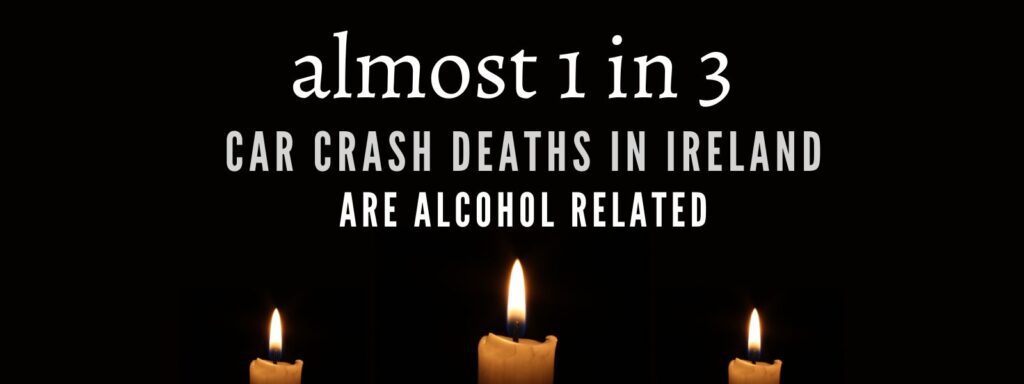
Alcohol impairment impacts road safety and drink driving is a major factor in road collisions and fatalities on the road. Analysis of coronial data found that 35% of driver fatalities (2016-2020) with a toxicology result available, had a positive toxicology for alcohol. Almost one in three crash deaths in Ireland is alcohol-related.
A study in France found that drivers under the influence of alcohol are 17.8 times more likely to be responsible for a fatal collision, and the proportion of fatal collisions which would be prevented if no drivers ever exceeded the legal limit for alcohol is estimated at 27.7%.
What is the Irish drink driving limit?
The legal Irish blood alcohol limits for professional, learner and novice drivers are:
- 20 milligrammes of alcohol per 100ml of blood
- 27 milligrammes of alcohol per 100ml of urine or
- 9 microgrammes of alcohol per 100ml of breath.
The legal Irish blood alcohol limits for fully licenced drivers in Category B are:
- 50 milligrammes of alcohol per 100ml of blood
- 67 milligrammes of alcohol per 100ml of urine or
- 22 microgrammes of alcohol per 100ml of breath.
What is the penalty for drink driving?
Drink driving / driving under the influence (DUI) is a serious offence. The penalties for driving with alcohol in your system vary depending on the type of driver and the concentration of alcohol.
Administrative penalty system
You will be issued with a fixed penalty notice if you hold a valid licence or permit at the time of the offence and your alcohol level is below a certain limit. If you pay the fine stated on the notice within 28 days, the additional penalty will be imposed but you will not have to go to court. You are not eligible for a drink driving fixed penalty notice if you have received a similar notice within the previous 3 years. The alcohol limits and penalties applied under the fixed penalty notice scheme are:
| Driver type | Concentration of alcohol | Fine | Additional penalty |
| Experienced drivers | a) 50+mg to 80mg of alcohol per 100ml of blood (b) 67+mg to 107mg of alcohol per 100ml of urine (c) 22+mcg to 35mcg of alcohol per 100ml of breath | €200 | 3 months disqualification |
| Experienced drivers | (a) 80+mg to 100mg of alcohol per 100ml of blood (b) 107+mg to 135mg of alcohol per 100ml of urine (c) 35+mcg to 44mcg of alcohol per 100ml of breath | €400 | 6 months disqualification |
| Other drivers | (a) 21mg to 80mg of alcohol per 100ml of blood (b) 27+mg to 107mg of alcohol per 100ml of urine (c) 9+mcg to 35mcg of alcohol per 100ml of breath | €200 | 3 months disqualification |
Court system
If you have to go to court the disqualification periods for drink driving convictions are as follows:
| Concentration of alcohol | First offence (period of disqualification) | Second offence (period of disqualification) |
(a) 50+mg to 80mg of alcohol per 100ml of blood (b) 67+mg to 107mg of alcohol per 100ml of urine (c) 22+mcg to 35mcg of alcohol per 100ml of breath | 6 months | 1 year |
a) 80+mg to 100mg of alcohol per 100ml of blood (b) 107+mg to 135mg of alcohol per 100ml of urine (c) 35+mcg to 44mcg of alcohol per 100ml of breath | 1 year | 2 years |
(a) 100+mg to 150mg of alcohol per 100ml of blood (b) 135+mg to 200mg of alcohol per 100ml of urine (c) 44+mcg to 66mcg of alcohol per 100ml of breath | 2 years | 4 years |
| (a) Exceeding 150mg of alcohol per 100ml of blood (b) Exceeding 200mg of alcohol per 100ml of urine (c) Exceeding 66mcg of alcohol per 100ml of breath | 3 years | 6 years |
The minimum disqualification on a first offence if you are convicted of being too intoxicated to be in proper control of your vehicle is 4 years. The minimum disqualification for a second or subsequent offence is 6 years. The judge has the discretion to increase these penalties. The maximum penalty exclusively for drink driving is €5,000 or 6 months in prison or both.
How long does it take for alcohol to leave your system?
It takes most people 1 to 2 hours to process 1 standard drink. After you stop drinking, the alcohol levels in your system can continue to rise for up to 3 hours. Nothing can speed up the metabolism of alcohol by your body. For example, drinking water or coffee, eating or having a shower will not affect how long alcohol stays in the system. For more information on how alcohol affects your ability to drive see the HSE’s website.
How long after drinking can I drive?
Because it takes most people 1 to 2 hours to process 1 standard drink, you should wait at least 1 hour per standard drink consumed after stopping drinking. One standard drink – which is enough to put someone over the limit – is the equivalent of a glass (half pint) of beer, a small glass of wine (100ml) or a pub measure of spirits (35.5ml). If planning to drink, you should plan not to drive.
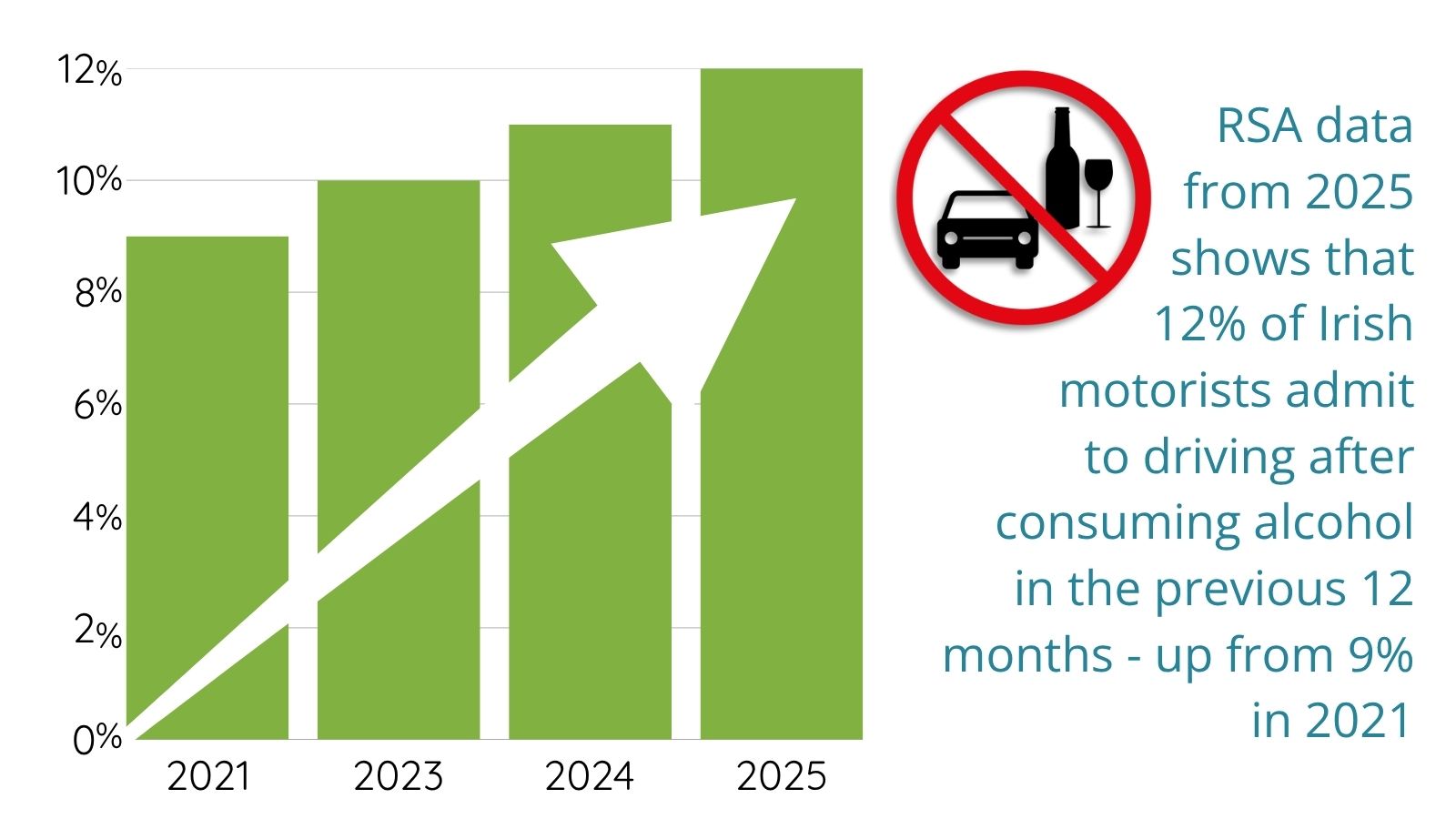
The Road Safety Authority’s drink driving statistics from December 2025 show that almost 1 in 8 (12%) of Irish motorists have admitted to driving after consuming alcohol in the past 12 months. This is up from 9% in 2021. Despite the known high level of drink driving, Ireland has lowest level of road side breath testing in the EU.
In 2025, gardai carried out 51,075 Mandatory Intoxication Testing (MIT) checkpoints, with 189,736 breath tests performed.
Year | ||||
2021 | 3,257,621 | 43,337 | 88,888 | 4,978 |
2022 | 3,325,487 | 49,981 | 150,049 | 5,500 |
2023 | 3,412,938 | 46,216 | 166,664 | 5,052 |
2024 | 3,538,732 | 52,661 | 194,693 | 5,002 |
2025 | 3,538,732 ** | 51,075 | 189,736 |
** 2024 data
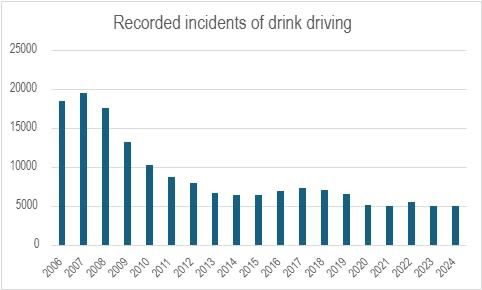
Almost half of all arrests for driving under the influence of an intoxicant take place between midnight and 6am. One in 10 DUI arrests are made between 8am and 2pm, with a peak on Sundays.
An analysis by An Garda Síochána of fatal, serious and non-serious injuries over the five Christmas and New Year periods from 2020-24 found that the risk of collision is at its highest between 3pm and 6pm.
Campaign: Alcohol and road safety
What needs to happen?
It is essential that road safety strategy should have a public health perspective. Given the current high level of drink driving in Ireland there is a need for a government-led drink driving taskforce which includes alcohol policy professionals, psychologists, road safety engineers, men’s health experts, gardai, mental health experts and communication experts. Areas which should be examined include:
- Act on the significant international evidence that reducing population-level alcohol consumption by enhancing controls on price, marketing and availability has an impact in reducing alcohol related collisions.
- Ireland should move to a target equal to every licensed driver being breath tested at least once a year – a standard that has been adopted in Australia and other jurisdictions.
- Ireland must address issues re the collection of blood samples from suspected drink drivers. Ireland should introduce the Australian system where any Emergency Dept (ED) doctor/nurse may take a sample and store it in a one-way safe in EDs to preserve the chain of evidence. This would greatly reduce the likelihood of an offender escaping detection.
- The window for taking blood samples following a collision must be extended from the current 3-hour limit to 12 hours. This is particularly relevant given the long distances to some hospitals from collisions in rural areas.
- Vehicles should be impounded at the time of a failed breath test, as is the case for uninsured vehicles.
- Drink driving offenders should be provided with access to treatment and there must be a significant enhancement of service provision.
- Introduce the alcohol ignition interlock system for offenders. The alcohol ignition interlock is a personal alcohol breath-test device for drivers that automatically prevents a vehicle from starting if the individual is over the limit.
- Gardaí must get greater resourcing to tackle drink driving.
- Ireland’s low level of drink driving convictions must be investigated and any legal loopholes must be closed.
- A welfare check on the family should be carried out when someone provides a positive breath test and there are children or juveniles present in the vehicle.
Read more
World Health Organization’s report, Road policing for road safety
The alcohol industry has long attempted to influence governments in regard to the blood alcohol concentrations (BACs) permissible for drivers of various ages, experience, licence classes and vehicle types. Reflective of its business models, its primary objective has always been to maximize alcohol consumption by drivers, while simultaneously limiting the liability of establishments that serve alcohol to individuals well beyond levels of driver impairment.
The approach of the alcohol industry towards the prevention of drink–driving is based on ineffective non-evidence-based interventions, such as education, self-regulation and designated driver programmes that maximize consumption, rather than supporting policies and legislation that reduce BAC limits (for example, 0.08 g/dL down to 0.05 g/dL for the general population, and 0.03 or 0.02 g/dL for novice and probationary drivers) and maximizing their implementation through intensive road policing and enforcement. The practices of the alcohol industry contribute to misinformation about the road safety risks and consequences of driving under the influence of alcohol.
On random breath testing:
The general deterrence impact of random breath testing (RBT), and its contribution to road safety outcomes, is profound. In Australia, where police in all state jurisdictions have RBT (and random drug testing (RDT)) powers, police implemented more than 175 million breath tests between 2008 and 2019 (ranging from 12–16 million RBTs per year). Over this time period, the proportion of drivers detected under the influence of alcohol decreased from 0.9% to 0.4%, and the percentage of alcohol associated road deaths decreased by 40%.
Read more
European Commission: Road safety data and analysis
European Commission: Road safety data and analysis, Ireland
European Commission: Road safety data and analysis, alcohol and drugs
European Commission: Road safety data and analysis, annual statistical report
We need your help!
AAI is running a campaign calling on government to act decisively to stamp out drink driving.
If you would like to help our campaign, please consider filling in the form below and individual, personalised emails will be sent to the local TDs of your choice.
There is a pre-filled message you can sign, or feel free to write your own.
It only takes a minute!
Thank you
Alcohol and driving FAQs
Does even a small amount of alcohol affect driving?
Yes. Even low levels of alcohol impair driving ability, including reaction time, coordination, and judgement, increasing crash risk.
At what level does alcohol begin to impair driving?
Driving performance can be impaired at blood alcohol concentrations as low as 0.02%, well below most legal limits.
What driving skills are affected by alcohol?
Alcohol affects vision, reaction time, concentration, coordination, and decision-making, and can increase risk-taking behaviour.
How common is alcohol in road fatalities in Ireland?
Over a third (35%) of driver fatalities (2016-2020) with a toxicology result available had a positive toxicology for alcohol.
How much does alcohol increase crash risk?
A study in France found that drivers under the influence of alcohol are 17.8 times more likely to be responsible for a fatal collision.
Are drink-driving incidents still common?
Yes. Almost one in eight drivers (12%) admit to drink driving – that’s around 424,500 people a year, many of whom drink drive multiple times a year.
What is the legal alcohol limit for driving in Ireland?
- Fully licensed drivers: 50 mg per 100ml of blood
- Learner, novice, and professional drivers: 20 mg per 100ml of blood
Do different countries have different legal limits?
Yes. Across the EU the legal limit ranges from 0 mg per 100ml of blood to 50 mg per 100ml of blood.
What happens if you are caught drink driving in Ireland?
Penalties include fines, mandatory driving disqualification, and potentially imprisonment depending on alcohol levels and offences.
What are the penalties for a first time drink driving conviction?
Typical penalties for a first offence can include fines (e.g. €200–€400) and disqualification periods starting from 3–6 months or longer depending on alcohol levels.
Can Gardaí test drivers without suspicion?
Yes. Under Irish law, Gardaí can conduct random breath testing at checkpoints without needing prior suspicion.
When are drink-driving arrests most common?
Almost half of all arrests for driving under the influence of an intoxicant take place between midnight and 6am. One in 10 DUI arrests are made between 8am and 2pm, with a peak on Sundays.
How many drink-driving arrests happen in Ireland?
In 2024, gardai carried out 52,661 Mandatory Intoxication Testing (MIT) checkpoints, with 194,693 breath tests performed resulting in 5,002 arrests.
Is enforcement in Ireland strong?
Ireland has lowest level of road side breath testing in the EU.
How long does alcohol stay in your system?
It typically takes 1–2 hours to process one standard drink, though this varies by individual. One standard drink is the equivalent of a glass (half pint) of beer, a small glass of wine (100ml) or a pub measure of spirits (35.5ml).
Can anything speed up alcohol elimination?
No. Drinking coffee, water, eating, or showering does not speed up alcohol metabolism.
Can your alcohol level rise after you stop drinking?
Yes. Blood alcohol levels can continue rising for up to 3 hours after drinking stops.
When is it safe to drive after drinking?
A general guideline is to wait at least one hour per standard drink consumed after stopping drinking — but even this may not guarantee you are under the legal limit.
Is there a safe amount of alcohol before driving?
No. Any amount of alcohol increases crash risk, so the safest option is not to drink at all before driving.
What measures can reduce drink driving?
Key strategies include increased enforcement, controls on price, marketing and availability of alcohol, public health campaigns, and ignition interlock systems.
What is an alcohol ignition interlock?
The alcohol ignition interlock is a personal alcohol breath-test device for drivers that automatically prevents a vehicle from starting if the individual is over the limit.
Should drink-driving offenders receive treatment?
Yes. Access to treatment for alcohol use disorders is recommended as part of prevention strategies.