Introduction
The alcohol industry, which is among the most active sectors seeking to influence policy and public opinion in Ireland, is a broad church, spanning producers, wholesalers, pubs, nightclubs, off-licences, and supermarkets. However diverse these interests may appear, they share one commercial objective – to maximise the volume of alcohol sold, thereby maximising profits.
To advance it, the industry presents its commercial interests as a public good. Proposed changes to Ireland’s licensing laws show this pattern clearly. The industry argues that longer opening hours and staggered closing times would ease pressure on our streets.[1] This is often an industry euphemism for fewer public order incidents. The evidence, however, tells a different story.
In this blog, Alcohol Action Ireland examines what the research says about opening hours, the density of licensed premises, and alcohol harm. Drawing on Irish experience, international studies, and the concerns of An Garda Síochána, it asks whether more hours to sell alcohol will make our communities safer, or less safe.
Opening hours
In their desire for the introduction of longer periods to sell alcohol, industry has made the argument that later licensing hours will reduce alcohol-fuelled violence across our towns and cities. They maintain that extending licensing hours would see the staggered exit of patrons from pubs, late bars, and nightclubs with different closing times, thereby reducing the volume of people on the streets simultaneously. This argument, however, is undermined by decades of evidence.
Rigorous academic research has shown that the availability and accessibility of alcohol are the main determinants of alcohol use and alcohol-related harm, such as violence, in the population. Indeed, this fact has been outlined by the World Health Organisation (WHO) through their SAFER initiative.[2] The WHO has consistently identified restrictions on alcohol availability, such as hours of sale, as a highly effective and cost effective ‘best-buy’ for the prevention and reduction of alcohol harm.
In order to understand why licensing hours and closing times for bars, pubs, and nightclubs is an important issue, then it is essential to understand the relationship between alcohol, public order, and violence. Alcohol and violence have a closely interconnected relationship, with alcohol consumption being a contributing factor to crime, violence, and antisocial behaviour. Alcohol plays a key role in crimes such as public order offences, domestic violence, assault and murder, as well as rape and sexual assault.[3]
While alcohol use is neither necessary nor sufficient for violence to occur, many studies have demonstrated significant, and positive, associations between alcohol consumption and rates of criminal violence, and we can say with confidence that more drinking tends to result in more violence, and less drinking tends to result in less violence.[4] Indeed, laboratory studies have shown that alcohol increases aggression.[5] [6] For example, it increases the willingness with which individuals will administer electric shocks to others.[7] [8] Such research is important when analysing licensing hours and the nature of public order and violence late at night.
National and international evidence consistently shows that increases in trading hours and density of licensed premises lead to more alcohol-related crime, violence, and public disorder, while reducing late-night trading lowers rates of violence. And while the WHO has identified restrictions on availability as among the most effective measures to reduce alcohol driven public order and violence,[9] addressing alcohol use remains an underutilised strategy in the violence prevention field. Indeed, relatively few prevention efforts intentionally address alcohol consumption or draw on effective strategies from the alcohol field.[10] This is especially true of alcohol-fuelled violence.[11]
Key facts
Alcohol is a major driver of crime in Ireland. As District Court President Justice Paul Kelly has observed, alcohol is implicated in the vast majority of public order offences, assaults, criminal damage, and family law cases, as well as drink driving. [12]
- Between 30–65% of assaults, disorderly conduct, and public order incidents are linked to alcohol; [13]
- Alcohol is a risk factor for domestic, sexual, and gender-based violence;[14]
- Department of Justice analysis indicates 29% of the costs of alcohol harm relate to crime. [15]
Internationally, the WHO released a comprehensive report reinforcing the public health considerations in relation to the sale of alcohol.[16] The paper states that communities with more alcohol establishments tend to have higher rates of alcohol consumption, violent crime, suicides, alcohol-related hospitalisations and deaths, and traffic collisions.[17]
It also notes, among many other salient points, alcohol licensing and establishment density are associated with a range of harms, including crime and violence.
International evidence
Internationally, a wealth of studies have demonstrated a link between the provision of alcohol and the occurrence of crime, violence, and disorder in the nighttime economy, particularly in town and city centres.[18] Global evidence is overwhelmingly clear that any changes in the number and density of licensed premises, as well as permitted trading hours, are associated with changes in the patterns of alcohol related harms, such as violent disorder.[19] In Ireland it is commonly believed that because European cities have liberal laws around licensed premises, they don’t have problems with alcohol and violence. This is not the case.
The Licensing Act 2003 in England enabled staggered closing times, with one of the stated aims of the Act being the reduction of violence and disorder at fixed, peak closing times. Research, however, demonstrated that there was no change in overall levels of violence, and that violence was shifted later into the night and for most hospitals, admissions relating to alcohol increased.[20]
Moreover, the burden of late-night violence falls heavily on the emergency services charged with managing it. The UK College of Policing notes that frustration or aggression in the night-time economy (NTE) can become focused on officers who intervene to enforce the law, with assaults most likely around 11pm and midnight. [21] For example, in north-east England, 97% of officers surveyed felt at risk of physical assault when policing the NTE, and one in five had been subject to six or more alcohol-related assaults during their career.[22] While an Institute of Alcohol Studies survey found that 41% of police respondents had been sexually harassed or assaulted by intoxicated people while on duty.[23] Such evidence shows how elongating trading hours only extends this exposure further into the night.
A study in Norway found that each additional one-hour extension to opening hours of licensed premises was associated with a 16% increase in violent crime,[24] while in the United States increases in the density of alcohol outlets has been linked to increased levels of domestic violence.[25] On this very island a 17% increase in alcohol related crime followed Northern Ireland’s extension of licensing hours in October 2021.[26] While research from the experiences of Perth, Australia, revealed that extending opening hours by an hour contributed to an increase in crime, violence and drink driving.[27]
National evidence
An Garda Síochána have regularly highlighted increases in alcohol-related offences which often fluctuate relative to the buoyancy of the night-time economy.[28] In 2017, Gardai reported that public drunkenness offences in Dublin were 40% higher than in 2016, and that public-order crime had increased 14%.[29] In 2019, Deputy Commissioner Twomey, said that the number of crimes against the person, including assaults, increases in the summer months, which he believed was related to the consumption of alcohol.[30]
We already know policing the night-time economy within built-up town and city centres is a resource intensive job.[31] Gardaí in Ireland are already under significant pressure as numbers remain below strength and issues surrounding recruitment and retention continue to place extra workload, stress and pressure on their members.[32] This has coincided with an escalation of assaults on Gardaí and intimidation.[33] Therefore, in the context of addressing alcohol-fuelled public order and violence, any extension of licensing hours will undoubtedly see an increase in crime and violence and result in additional pressure on Gardaí.[34] Indeed, An Garda Síochána articulated such concerns in their submission to the Oireachtas Justice Committee Pre-Legislative Scrutiny of the General Scheme of the Sale of Alcohol Bill.[35]
These concerns were further reinforced in private meetings with the Department of Justice where Gardaí revealed their belief that any proposed licensing changes “will present a serious issue from a resource and rostering perspective” as “there are insufficient resources to deal with the existing situation of 2.30am closing times as it is and… this will exacerbate the demands on an already overwhelmed force.”.[36] Indeed, An Garda Siochana were unequivocal that more public order and associated issues would be the inevitable consequence of extending licensing hours.[37]
However, Ireland already has evidence that extending licensing hours results in more crime and violence. It is of note that after licensing hours on Thursdays, Fridays and Saturdays were extended under the Intoxicating Liquor Act 2000, a significant increase in alcohol-related crime was recorded. The extension of opening hours from 11.30pm to 12.30am saw a 16.5% increase in alcohol-fuelled disorder, which matches comparable international data.
Such was scale of disorder and violence that the Commission on Liquor Licensing recommended that the extended hours on Thursdays should be discontinued.[38] This was done in 2003. Doubtless, any extension in licensing hours would again see a similar increase in alcohol related crime and violence across Ireland.
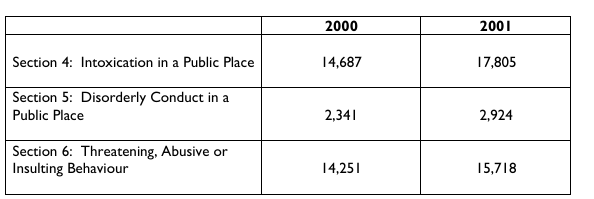
Fig. 1: The number of public order offences, pre and post licensing hours extension, in cases in which proceedings were taken.[39]
However, the inverse is also the case, and we know that reductions in licensing hours lead to less harm. Studies in Switzerland, Australia and New Zealand have demonstrated that reducing late night opening hours substantially reduces rates of violence.[40] While analysis of stronger licensing controls in certain districts in Sydney saw assault cases reduce by as much as 52.8% in some areas.[41]
Evidence in relation to density of alcohol outlets
In November 2022, the World Health Organisation released a comprehensive report reinforcing the public health considerations in relation to the sale of alcohol.[42] The report notes that the density of and proximity to alcohol establishments have long been associated with violence, pedestrian injuries, suicide, and long-term chronic harm such as cancer, and increased deaths. The evidence is particularly robust for suicide, alcohol-related deaths, violence, and child maltreatment. Meanwhile a comprehensive study from New Zealand demonstrated that greater geographic access to alcohol outlets was associated with increased levels of serious violent offending. [43] Indeed, increased density of alcohol outlets is associated with increased levels of alcohol harm and in particular studies have shown increased levels of domestic violence. [44]
For example, a US report published in November 2022 found a very clear relationship between the level of alcohol use and child abuse in neighbourhoods analysed in California.[45] The same study noted having one more off-premises alcohol outlet, on average, was related to a 13.5% increase in substantiated instances of child abuse and neglect.[46]
Controls on availability
Thankfully, there are proven policy solutions to reduce alcohol-fuelled crime and violence. Comprehensive Australian research found restrictions on alcohol trading hours to be successful in reducing violence outside pubs and nightclubs by 37%.[47] Further research from the country reinforced this and its success was acknowledged, even by nightclub owners, to improve safety of patrons and allowed for ‘the development of better business strategies to increase patron numbers’. [48] Conversely, research also suggests liberalising the availability of alcohol can lead to increased consumption and, therefore, problems such as public disorder, crime and violence.[49]
Studies in Switzerland and New Zealand have also demonstrated that reducing late night opening hours substantially reduces rates of violence.[50] While analysis of stronger licensing controls in certain districts in Sydney saw assault cases reduce by as much as 52.8% in some areas.[51]
Concern for public safety in the face of alcohol-related crime and violence has been the catalyst for similar licensing restrictions in several countries. Earlier this year the Croatian city of Split banned the sale of alcohol in shops from 8 p.m. to 6 a.m. in a measure the city’s Mayor described as a concrete solution to growing problems linked to alcohol consumption, public disorder and the wellbeing of young people.[52] This move follows similar licensing restrictions in Warsaw, Poland where restrictions on late-night alcohol sales in some of the city’s districts have been piloted. The move sees alcohol sales banned between 10:00 p.m. to 6:00 a.m. at grocery stores or gas stations. The restrictions follow similar moves in other Polish cities, towns, and districts as approximately 180 municipalities introduced similar measures since 2018.[53]
Similarly, several districts in the Belgian capital of Brussels have seen curbs on public drinking late at night in a bid to tackle anti-social behaviour.[54] Latvia, however, has gone a step further in their attempts to reduce violence and support public health by condensing off-license alcohol sales to between 10am and 8pm from Monday to Saturday, and from 10am to 6pm on Sundays.[55]
In Spain, across the Balearic islands of Ibiza and Majorca, significantly tougher licensing was enacted between 2020 and 2024.[56] Changes in licensing now means drinking on public streets is prohibited, happy hours, pub crawls and two-for-one drink offers are banned, and it is prohibited to sell alcohol in shops between 9.30pm and 8am.[57] Penalties for breaching restrictions range from fines of €750 to €3,000.[58] The stated aim of the new restrictions is to curb binge drinking and reduce anti-social behaviour.
Conclusion
The national and international evidence is consistent, when alcohol is more available, either through increased hours of sale or increased sales locations, harm increases. The inverse is also true – when availability is reduced, harm decreases. Ireland has already learned this the hard way after deregulatory changes in 2000, when longer opening hours were followed by a 16.5% rise in alcohol-fuelled disorder. Norway, Northern Ireland, and Perth have seen the same patterns.
Meanwhile, cities across Europe are moving to restrict late-night sales, not extend them. With frontline services already stretched, extending licensing hours would place further pressure on our communities, on Gardaí, on ambulance crews and paramedics, and on Emergency Department doctors and nurses.
AAI believes government policy should be guided by evidence, not the bottom line of the alcohol industry.
References
[1] Licensed Vintners Association. (2021, September 15). New licensing system must be fair and balanced – LVA. https://www.lva.ie/new-licensing-system-must-be-fair-and-balanced-lva/
[2] World Health Organization. (n.d.). The SAFER initiative. Retrieved November 9, 2026, from https://www.who.int/initiatives/SAFER
[3] Byrne, S. (2010) Costs to Society of Problem Alcohol Use in Ireland. Dublin: Health Service Executive. Available at: https://www.drugsandalcohol.ie/15781/1/HSE_Costs_to_Society_of_Problem_Alcohol_Use_in_Ireland.pdf
[4] Room, R., Rossow, I., (2009). The share of violence attributable to drinking. Journal of Substance Use, 6(4), 218–228. Available at: https://www.tandfonline.com/doi/abs/10.1080/146598901753325048
[5] https://pubmed.ncbi.nlm.nih.gov/17894385/
[6] https://research.bond.edu.au/en/studentTheses/critical-analysis-of-the-law-surrounding-one-punch-killings/
[7] Giancola, P. R., & Parrott, D. J. (2008). Further evidence for the validity of the Taylor Aggression Paradigm. Aggressive Behavior, 34(2), 214–229. https://pubmed.ncbi.nlm.nih.gov/17894385/
[8] Burgess, C. (2016). Critical analysis of the law surrounding “one punch” killings. Bond University Research Portal. https://research.bond.edu.au/en/studentTheses/critical-analysis-of-the-law-surrounding-one-punch-killings/
[9] World Health Organization. (n.d.). The SAFER initiative. Retrieved September 29, 2026, from https://www.who.int/initiatives/SAFER
[10] Prevention Collaborative. (2024). Addressing harmful alcohol use to reduce intimate partner violence and violence against children in the home. Available at: https://prevention-collaborative.org/wp-content/uploads/2024/09/Alcohol-Review-FINAL.pdf
[11] Prevention Collaborative. (2024). Addressing harmful alcohol use to reduce intimate partner violence and violence against children in the home. Available at: https://prevention-collaborative.org/wp-content/uploads/2024/09/Alcohol-Review-FINAL.pdf
[12] Carolan, M., Carswell, S. (2022). Inside Ireland’s District Courts: ‘If alcohol disappeared overnight, the courts could close’. Dublin: The Irish Times. Available at: https://www.irishtimes.com/news/crime-and-law/courts/district-court/inside-ireland-s-district-courts-if-alcohol-disappeared-overnight-the-courts-could-close-1.4781655
[13] Doyle, A., Mongan, D., Galvin, B. (2024). Alcohol: availability, affordability, related harm, and policy in Ireland. HRB Overview Series 13. Dublin: Health Research Board. Available at: https://www.hrb.ie/wp-content/uploads/2024/06/HRB_Alcohol_Overview_Series_13.pdf
[14] Byrne, S. (2010) Costs to Society of Problem Alcohol Use in Ireland. Dublin: Health Service Executive. Available at: https://www.drugsandalcohol.ie/15781/1/HSE_Costs_to_Society_of_Problem_Alcohol_Use_in_Ireland.pdf
[15] Department of Public Expenditure, NDP Delivery and Reform. (2024). Budget 2025 Expenditure Report. Dublin: Government of Ireland. Available at: https://www.gov.ie/pdf/?file=https://assets.gov.ie/306561/8eaf388a-6f39-4fe6-8200-c68960587cbe.pdf#page=null
[16] World Health Organization. (2022). A public health perspective on alcohol establishments: Licensing, density and locations (Snapshot series on alcohol control policies and practice, Brief 8). https://www.who.int/publications/i/item/9789240061385
[17] World Health Organization. (2022). A public health perspective on alcohol establishments: Licensing, density and locations (Snapshot series on alcohol control policies and practice, Brief 8). https://www.who.int/publications/i/item/9789240061385
[18] Newton, Dr. A. and Hirschfield, Prof. A. (2009). Violence and the Night-Time Economy: A multi-professional perspective An Introduction to the Special Edition. Crime Prevention and Community Safety 11(3):147-152. Available at: https://irep.ntu.ac.uk/id/eprint/42432/1/1412405_Newton.pdf
[19] Burton R, Henn C, Lavoie D, O’Connor R, Perkins C, Sweeney K, Greaves F, Ferguson B, Beynon C, Belloni A, Musto V, Marsden J, Sheron N. A rapid evidence review of the effectiveness and cost-effectiveness of alcohol control policies: an English perspective. Lancet. 2017 Apr 15;389(10078):1558-1580. doi: 10.1016/S0140-6736(16)32420-5
[20] Burton R, Henn C, Lavoie D, O’Connor R, Perkins C, Sweeney K, Greaves F, Ferguson B, Beynon C, Belloni A, Musto V, Marsden J, Sheron N. A rapid evidence review of the effectiveness and cost-effectiveness of alcohol control policies: an English perspective. Lancet. 2017 Apr 15;389(10078):1558-1580. doi: 10.1016/S0140-6736(16)32420-5
[21] Johnson, L. (2023). College of Policing – Going Equipped: Assaults on police – culture, legitimacy and risk. Coventry: College of Policing Limited. Issue 6, Spring/Summer 2023. Available at: https://library.college.police.uk/docs/college-of-policing/Going-equipped-Spring-Summer-2023.pdf
[22] Balance – The North East Alcohol Office. (2013). The impact of alcohol on Policing in the North East. Durham: Balance North East. Available at: https://www.ias.org.uk/uploads/pdf/News%20stories/balance-report-march2013.pdf
[23] Institute of Alcohol Studies. (2015). Alcohol’s impact on emergency services. London: IAS. Available at: https://www.ias.org.uk/uploads/Alcohols_impact_on_emergency_services_full_report.pdf
[24] Rossow, I., & Norström, T. (2012). The impact of small changes in bar closing hours on violence. The Norwegian experience from 18 cities. Addiction, 107(3), 530–537. https://pmc.ncbi.nlm.nih.gov/articles/PMC3380552/
[25] Kearns, M. C., Reidy, D. E., & Valle, L. A. (2015). The role of alcohol policies in preventing intimate partner violence: A review of the literature. Journal of Studies on Alcohol and Drugs, 76(1), 21–30. https://pmc.ncbi.nlm.nih.gov/articles/PMC4770459/
[26] Police Service of Northern Ireland. Police recorded crime statistics. https://www.psni.police.uk/about-us/our-publications-and-reports/official-statistics/police-recorded-crime-statistics
[27] Chikritzhs, T. and Stockwell, T. The impact of later trading hours for Australian public houses (hotels) on levels of violence. J Stud Alcohol, 2002 Sep;63(5):591-9. Available at: https://pubmed.ncbi.nlm.nih.gov/12380856/
[28] Lally, C. (2017, November 15). Alcohol-related crime booms in Dublin as nightlife picks up. The Irish Times. https://www.irishtimes.com/news/crime-and-law/alcohol-related-crime-booms-in-dublin-as-nightlife-picks-up-1.3291974
[29] Lally, C. (2017, November 15). Alcohol-related crime booms in Dublin as nightlife picks up. The Irish Times. https://www.irishtimes.com/news/crime-and-law/alcohol-related-crime-booms-in-dublin-as-nightlife-picks-up-1.3291974
[30] Lally, C. (2019, September 26). Head of Policing Authority says public unconcerned about chief superintendents. The Irish Times. https://www.irishtimes.com/news/crime-and-law/head-of-policing-authority-says-public-unconcerned-about-chief-superintendents-1.4031788
[31] Institute of Alcohol Studies. (2015). Alcohol’s impact on emergency services. London: IAS. Available at: https://www.ias.org.uk/uploads/Alcohols_impact_on_emergency_services_full_report.pdf
[32] Reynolds, P. (2024). Increase in assaults on gardaí and politicians, says GRA. Dublin: RTÉ. Available at: https://www.rte.ie/news/ireland/2024/0422/1444873-gra-conference/
[33] Reynolds, P. (2024). Increase in assaults on gardaí and politicians, says GRA. Dublin: RTÉ. Available at: https://www.rte.ie/news/ireland/2024/0422/1444873-gra-conference/
[34] Dunphy, L. (2024). More assaults and ‘overzealous oversight’ make policing ‘even tougher’, Garda conference told. Cork: Irish Examiner. Available at: https://www.irishexaminer.com/news/arid-41380474.html
[35] Houses of the Oireachtas – Joint Committee on Justice. (2023). Report on Pre-Legislative Scrutiny of the General Scheme of the Sale of Alcohol Bill 2022. Dublin: Houses of the Oireachtas. Available at: https://data.oireachtas.ie/ie/oireachtas/committee/dail/33/joint_committee_on_justice/reports/2023/2023-03-02_report-on-pre-legislative-scrutiny-of-the-general-scheme-of-the-sale-of-alcohol-bill-2022_en.pdf
[36] O’Keeffe, C. (2024). Gardaí fear extended opening hours will worsen public order problems. Cork: Irish Examiner. Available at: https://www.irishexaminer.com/news/arid-41510051.html
[37] O’Keeffe, C. (2024). Gardaí fear extended opening hours will worsen public order problems. Cork: Irish Examiner. Available at: https://www.irishexaminer.com/news/arid-41510051.html
[38] Commission on Liquor Licensing. (2001). Interim report on off-licensing. Stationery Office. https://www.drugsandalcohol.ie/5549/1/Commission_on_liquor_licensing_interim_report.pdf
[39] Commission on Liquor Licensing. (2003). Final report. Department of Justice. https://www.drugsandalcohol.ie/5432/1/1683-1588.pdf
[40] Wicki M, Bertholet N, Gmel G. Estimated changes in hospital admissions for alcohol intoxication after partial bans on offpremises sales of alcoholic beverages in the canton of Vaud, Switzerland: an interrupted time-series analysis. Addiction. 2020 Aug;115(8):1459-1469. doi: 10.1111/add.14967. Epub 2020 Feb 5. PMID: 31925836.
[41] Schumann, J. L., Sarkar, R., Grbic, M., Drummer, O. H., Gerostamoulos, D., Iles, L., & Bassed, R. (2023). Changing trends and characteristics of one punch deaths in Australia (2012–2018). Forensic Science International, 345, Article 111621. https://www.sciencedirect.com/science/article/pii/S0379073823000713
[42] A public health perspective on alcohol establishments: licensing, density and locations. Brief 8, November 2022. Geneva: World Health Organization; 2022. Snapshot shttps://apps.who.int/iris/rest/bitstreams/1476533/retrieve
[43] Day, P., Breetzke, G., Kingham, S. and Campbell, M. (2012), Close proximity to alcohol outlets is associated with increased serious violent crime in New Zealand. Australian and New Zealand Journal of Public Health, 36: 48-54. https://doi.org/10.1111/j.1753-6405.2012.00827.x
[44] Centers for Disease Control and Prevention. Guide for Measuring Alcohol Outlet Density. Atlanta, GA: Centers for Disease Control and Prevention, US Dept of Health and Human Services; 2017
[45] Freisthler, B., Kranich, C., Price Wolf, J., Boyd, R. & Gruenewald, P.J. (2022) Neighborhood market potentials for alcohol use and rates of child abuse and neglect. Alcoholism: Clinical and Experimental Research, 00, 1– 12. Available from: https://doi.org/10.1111/acer.14975
[46] Freisthler, B., Kranich, C., Price Wolf, J., Boyd, R. & Gruenewald, P.J. (2022) Neighborhood market potentials for alcohol use and rates of child abuse and neglect. Alcoholism: Clinical and Experimental Research, 00, 1– 12. Available from: https://doi.org/10.1111/acer.14975
[47] Burgess, C. (2016). Critical analysis of the law surrounding “one punch” killings. Bond University Research Portal. https://research.bond.edu.au/en/studentTheses/critical-analysis-of-the-law-surrounding-one-punch-killings/
[48] Burgess, C. (2016). Critical analysis of the law surrounding “one punch” killings. Bond University Research Portal. https://research.bond.edu.au/en/studentTheses/critical-analysis-of-the-law-surrounding-one-punch-killings/
[49] Room, R., Babor, T., & Rehm, J. (2005). Alcohol and public health. The Lancet, 365(9458), 519–530. https://doi.org/10.1016/S0140-6736(05)17870-2
[50] Wicki M, Bertholet N, Gmel G. Estimated changes in hospital admissions for alcohol intoxication after partial bans on offpremises sales of alcoholic beverages in the canton of Vaud, Switzerland: an interrupted time-series analysis. Addiction. 2020 Aug;115(8):1459-1469. doi: 10.1111/add.14967. Epub 2020 Feb 5. PMID: 31925836.
[51] Schumann, J. L., Sarkar, R., Grbic, M., Drummer, O. H., Gerostamoulos, D., Iles, L., & Bassed, R. (2023). Changing trends and characteristics of one punch deaths in Australia (2012–2018). Forensic Science International, 345, Article 111621. https://www.sciencedirect.com/science/article/pii/S0379073823000713
[52] Croatia Week. (2026, May 16). Split announces plans to restrict alcohol sales between 9pm and 6am. https://www.croatiaweek.com/split-alcohol-sales-ban-night-time-restrictions/
[53] TVP World. (2025, November 1). Nighttime alcohol sales ban rolls out in two Warsaw districts. https://tvpworld.com/89504452/warsaw-alcohol-sales-ban-launches-in-polands-capital
[54] Mokrani, F. (2025, March 31). This Brussels district is cracking down on public drinking with strict new nightlife rules. Euro Weekly News. https://euroweeklynews.com/2025/03/31/this-brussels-district-is-cracking-down-on-public-drinking-with-strict-new-nightlife-rules/
[55] Baltic News Network. (2025, July 31). New restrictions on the availability and advertising of alcohol will come into effect from August. BNN. https://bnn-news.com/new-restrictions-on-the-availability-and-advertising-of-alcohol-will-come-into-effect-from-august-270393
[56] Sky News. (2024, May 10). New alcohol ban in Majorca and Ibiza marks fresh clampdown on ‘excessive tourism’. https://news.sky.com/story/new-alcohol-ban-in-majorca-and-ibiza-marks-fresh-clampdown-on-excessive-tourism-13133007
[57] McSorley, A., & Boyd, M. (2026, May 3). Spain holiday warning as six drink limit hits Irish tourists this summer. Irish Mirror. https://www.irishmirror.ie/lifestyle/travel/spain-holiday-warning-six-drink-37105019
[58] McSorley, A., & Boyd, M. (2026, May 3). Spain holiday warning as six drink limit hits Irish tourists this summer. Irish Mirror. https://www.irishmirror.ie/lifestyle/travel/spain-holiday-warning-six-drink-37105019

