Guest blog by Sinéad Gibney TD

Forty years ago this month, the then Minister for Health Barry Desmond put his signature to a regulation requiring health warnings on cigarette packets. Despite all the available evidence supporting his decision, the move was opposed, delayed, and derided by an industry that questioned the science and made clear that economic profit mattered more than public health.
Moreover, Minister Desmond’s efforts were undermined internally by a Department of Industry that did the bidding of the tobacco companies. Today, those warnings are universally accepted as self-evident common sense with an unqualified public health benefit.
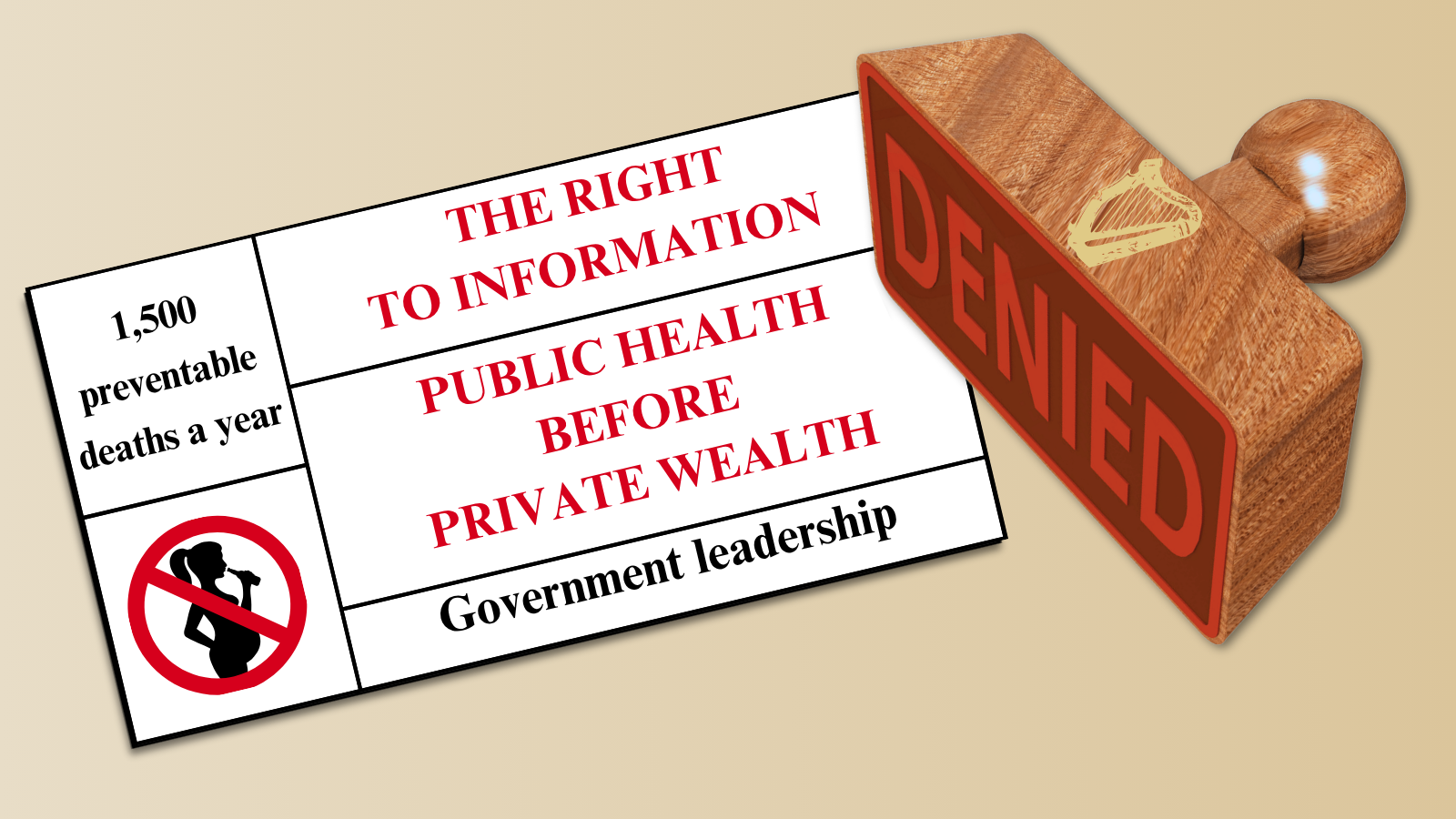
This week could have marked a similar milestone. Alcohol health information labels, a central provision of the Public Health (Alcohol) Act 2018 (PHAA), were due to come into effect on May 22. But they won’t, because the industry arguments that failed 40 years ago with tobacco found more currency with the current Government.
Just under a year ago, I asked the Minster for Enterprise about this change of direction. I spoke about my own personal experience with alcohol, and how it has taken a lot from me. I gave up alcohol 14 and a half years ago because, as I explained in the Dáil at the time, the negative impacts of alcohol have played a huge part in my life.
But it’s important to highlight that apart from addiction, there are other health implications from the consumption of alcohol – clear, evidenced, and frightening implications, which are sometimes exacerbated by addiction but are standalone issues in and of themselves.
Industry lobbying ultimately secured the delay to alcohol health labels until 2028. But it is worth recounting how the Government decision to postpone this important public health measure was arrived at.
The alcohol industry has always opposed health information labels. And just like the tobacco industry before it, it will do anything to protect its interests.
The campaign against labelling has been relentless, operating simultaneously at national, EU, and global level. At home, the industry spent considerable time, money, and political capital lobbying against the measures during the PHAA debate. At European level, big alcohol, alongside sympathetic member states, lodged complaints and objections citing trade concerns with the EU Commission. When the commission ruled that labels would not affect trade, the industry turned its attention to Europe’s Beating Cancer Plan, successfully torpedoing proposals for harmonised EU-wide labelling, meaning each country must now go it alone or have no warnings at all.
At World Trade Organisation (WTO) level, several countries made comments that closely mirrored industry talking points, such as downplaying the link between alcohol and cancer; invoking spurious claims about health benefits; and repeatedly raising trade concerns. However, as with the EU Commission, this approach ultimately failed, culminating in no country raising any objections at the most recent meetings of the WTO Committee on Technical Barriers to Trade.
As with tobacco in 1986, the health harms of alcohol are unquestionable. When comprehensive warnings were introduced on tobacco products, smoking was responsible for an estimated 5,000 deaths a year. Today, alcohol is responsible for nearly 1,500 deaths annually (four every day), with around 1,000 alcohol-related cancers diagnosed each year. This is because alcohol is a Group 1 carcinogen, in the same category as tobacco, having a causal role in many cancers of the oral cavity, pharynx, larynx, oesophagus, liver, colon, rectum, and breast, with probable links to stomach and pancreatic cancers.
Knowing that the health and trade facts were irrefutable, the industry embarked on a misinformation campaign, exploiting uncertainty around EU-US tariffs to claim, falsely, that labelling would damage Irish exports. To generate confusion, it employed a communications model called ‘policy dystopia’, flooding the media with alarming economic narratives while simultaneously lobbying politicians to abandon their commitment to labelling.
However, the facts were straightforward. Health labels would have only applied to products sold in Ireland, with exports entirely exempt. Products sold here needed nothing more than a sticker carrying the relevant warnings. Alcohol producers already manage multiple label variants for different international markets, and over recent months hundreds of products appeared on Irish shelves already carrying health labels in anticipation of this month’s deadline. Unfortunately, many of those previously labelled products, such as Bulmer’s Cider, have begun dropping the warnings from containers.
Interestingly, just as the Department of Industry applied pressure to the Minister for Health in 1986, the Department of Enterprise and its Minister, Peter Burke, did similarly in 2025. Unlike 40 years ago, however, this time the Minister for Health, Jennifer Carroll McNeill, buckled under external industry and internal political pressure and postponed these crucial public health warnings. Ireland has now gone from world leader on alcohol labelling to bystander, while countries like Canada have replicated Ireland’s original approach and are progressing their own alcohol health information labelling legislation.
The actions of the alcohol industry, and the weakness of the Government, have ensured labelling is delayed until 2028. By the time the revised introduction date arrives, almost 3,000 lives will have been lost to alcohol. Any further delay represents capitulation to industry. And the public health consequences will be measured in lives.
Sinéad Gibney is the Social Democrats spokesperson on enterprise and a TD for Dublin Rathdown

