Alcohol and road safety
Alcohol – a major factor in road safety
Recent years have seen a significant toll on Irish roads with 2025 being the worst year for fatalities since 2014. Alcohol is a serious factor in relation to road safety in Ireland. Analysis of coronial data found that 35% of driver fatalities (2016-2020) with a toxicology result available, had a positive toxicology for alcohol[1].
A study in France[2] found that drivers under the influence of alcohol are 17.8 times more likely to be responsible for a fatal accident, and the proportion of fatal accidents which would be prevented if no drivers ever exceeded the legal limit for alcohol is estimated at 27.7%. However, there are proven measures to reduce drink driving and given the toll on our roads from alcohol, it is essential that all such policy levers are implemented.
Enhanced enforcement of current laws - significant increase in random breath testing needed
According to research[3] from the Road Safety Authority published in 2025, one in eight drivers admit to drink driving in the past year which is an increase of 20% on the previous year. This is approximately 400,000 people taking a lethal weapon onto roads in Ireland each year. However, in 2023 there were just 8,863 arrests for drink driving[4] while in 2024 this reduced to around 7500[5]. So, drink drivers are not likely to be caught.
This is not surprising as Ireland has the lowest level of roadside breath test checkpoints in the EU according to data from the European Transport Safety Council[6]. AAI strongly recommends that Ireland should move to a target equal to every licensed driver being breath tested at least once a year – a standard that has been adopted in Australia and other jurisdictions. There is significant evidence of the efficacy of this approach and for its cost-effectiveness.[7] For example, 14% of driver fatalities[8] in Australia have a positive toxicology for alcohol compared with 35% in Ireland.
Improvements in current legislation needed in relation to offending
Alongside enforcement of current legislation there are also a number of issues which should be addressed with additional legislation.
- Act on the significant international evidence that reducing population level alcohol consumption by enhancing controls on price, marketing and availability has an impact in reducing alcohol related collisions.
- Ireland should move to a target equal to every licensed driver being breath tested at least once a year – a standard that has been adopted in Australia and other jurisdictions.
- Confiscation of vehicle at time of a failed breath test as is the case for uninsured vehicles.
- Extend window for taking blood samples following a collision. There is a need for an extension of the current 3-hour limit to 12 hours. This is particularly relevant given the long distances to some hospitals from collisions in rural areas.
- Sample should not need to be taken under Garda caution. Introduce Australian system where any Emergency Dept, doctor/nurse may take a sample and stores it in a one-way safe in EDs to preserve the chain of evidence. This would greatly reduce the likelihood of an offender escaping detection.
- Alcohol ignition interlock system – The alcohol ignition interlock system should be introduced for offenders. The alcohol ignition interlock is a personal alcohol breath-test device for drivers that automatically prevents a vehicle from starting if the individual is over the limit. This has been under consideration by government for some years, but progress seems to have stalled.[9]
- Drink driving offenders should be provided with access to treatment and there must be a significant enhancement of service provision.
- Ireland’s low level of drink driving convictions must be investigated and any legal loopholes must be closed.
- A welfare check on the family should be carried out when someone provides a positive breath test and there are children or juveniles present in the vehicle.
- Gardaí must get greater resourcing to tackle drink driving.
Improving road safety by reducing Ireland’s high alcohol consumption
Detection of offending behaviour and enforcement of legislation is essential. However, there is also a strong case for prevention measures. There is significant evidence that reducing population level alcohol consumption by enhancing current controls on price, marketing and availability will have an impact in reducing alcohol related collision injuries.
While alcohol consumption per capita has decreased in recent years, partly as a result of legislation such as the Public Health (Alcohol) Act 2018, Ireland is still consuming at high levels and we have the second highest level of binge drinking across OECD countries.[10] To put this in context, if Ireland’s adult drinking population were consuming alcohol within the current HSE lower-risk guidelines, consumption per capita would be around a third lower. Consistent efforts across government to reach this target would provide many benefits, including improvements in road safety.
Ireland’s highly affordable alcohol
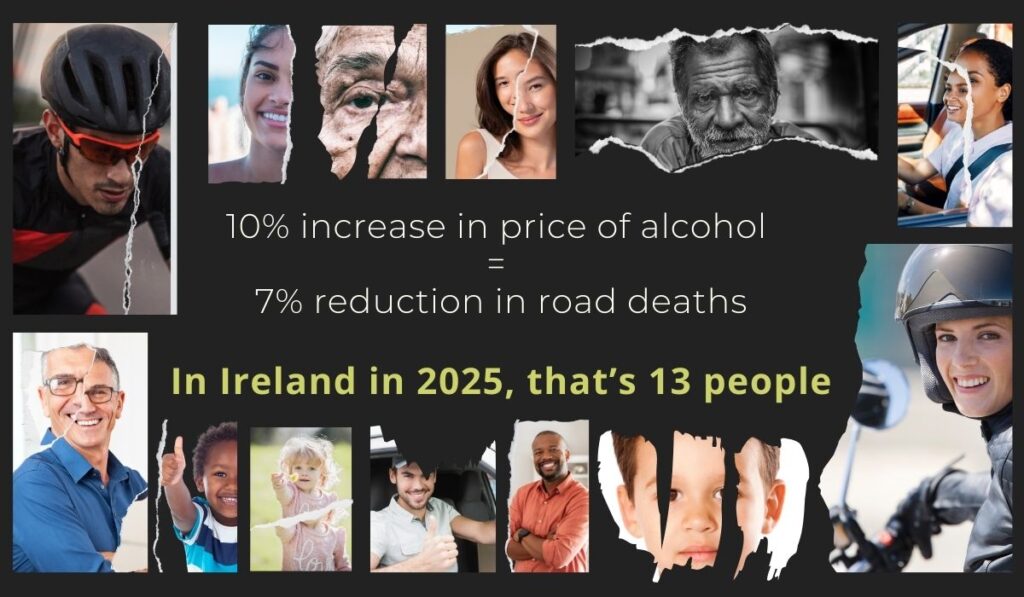
Research across the EU indicates that a 10% increase in alcohol prices is associated with a 7% reduction in road deaths.[11] In Ireland, the main policy levers in relation to alcohol prices are excise duties, which are set by the Minister for Finance and the level of Minimum Unit Pricing of alcohol which is set by the Minister for Health. However there has been no increase in excise duties in over 12 years and the level of MUP which was introduced in 2022 was actually first proposed in 2015 and needs to be increased in line with inflation.
The net result is that alcohol in Ireland is very affordable. In fact, alcohol for sale in shops is the same price today as it was 20 years ago with research from Sheffield University indicating it is now 85% more affordable.[12] We were disappointed that in the October budget there was no change to alcohol excise duties and believe this is a missed opportunity to reduce deaths on Irish roads.
Marketing
Ireland has some modest controls on advertising which are designed to protect children from exposure to alcohol marketing. These arise from the Public Health (Alcohol) Act 2018. However, this legislation is still not fully implemented with important measures such as controls on the content of alcohol advertisements not yet introduced. In addition, there are no statutory controls in relation to online alcohol marketing and there is significant evidence of children’s exposure to such marketing which promotes alcohol as a risk-free product essential to everyday life and its linkages to increased youth drinking.[13]
This is particularly concerning given the evidence around youth and road safety. For example, a HRB analysis[14] of Garda PULSE data found that 14% of drink-driving arrests were of young people aged 18-24 years, while data from the Road Safety Authority indicates that one-half (49%) of young driver fatalities during 2013–2017, with a toxicology result available, were positive for alcohol.
Such gaps in our laws around alcohol marketing must be addressed.
Availability
There is also a significant body of research which shows the link between increased alcohol availability through longer licensing hours and impacts on road safety.[15] For example, a one-hour extension of late-night opening hours is associated with a 30% increase in road collisions in rural areas.[16] The Programme for Government states there are plans to introduce changes to licensing hours through the Sale of Alcohol Bill/Intoxication Liquor Bill which are in development with the Department of Justice. It is essential that the Government does not make a bad situation worse through such actions.
Enhanced treatment services
As noted, Ireland has a significant issue with alcohol consumption. Research from the Health Research Board[17] finds that more than half of all who drink are classified as hazardous drinkers and around 20% have an Alcohol Use Disorder – that’s around 600,000 people. Despite these high numbers, in 2024, only 8745 accessed alcohol treatment.[18]
There is significant evidence from the analysis of blood samples by the Medical Bureau of Road Safety[19] that many are driving when several times over the legal limit and there is a high level of repeat offenders for example 263 drivers were arrested twice in 2024 – this is an increase of 8% on 2023. Such data suggests the likelihood of Alcohol Use Disorders within this cohort. We strongly urge that offenders should be provided with access to treatment and that there is a significant enhancement of service provision.
In addition, where someone provides a positive breath test and there are children or juveniles present in the vehicle, AAI recommends that the appropriate services should be notified of the incident to facilitate a welfare check on the children and family. This is incredibly import as we know that alcohol is a risk factor for child neglect and abuse as well as domestic, sexual, and gender-based violence.
Conclusion
Alcohol is a critical issue for road safety in Ireland. However, policy solutions are available which would make a significant impact. These require a whole of government commitment with co-ordinated actions across multiple departments including Finance, Justice, Health, Media and Transport. There is strong public support for action to address Ireland’s alcohol issues despite opposition from vested interests. Surely the government must call time on drink driving on Irish roads.
[1] https://www.rsa.ie/docs/default-source/road-safety/r4.1-research-reports/safe-road-use/contributory-factors-and-driver-fatalities-examining-2016-2020-coronial-data.pdf
[2] https://journals.plos.org/plosone/article?id=10.1371/journal.pone.0187320
[3]Launch of Christmas Road Safety Campaign
[4] One in 10 have driven after consuming alcohol in the last 12 months – according to new research by the RSA
[5] Gardaí made arrests for drink- and drug-driving once every hour last year, Garda Commissioner says
[6] The lowest level of road side breath test checkpoints in the EU
[7] Babor, Thomas F., and others, ‘Drinking and driving: prevention and countermeasures’, Alcohol: No Ordinary Commodity: Research and public policy, 3rd edn (Oxford, 2022; online edn, Oxford Academic, 19 Jan. 2023), https://doi.org/10.1093/oso/9780192844484.003.0011, accessed 29 July 2025.
[8] Australian drug driving deaths have surpassed drink driving. Here’s how to tackle it
[9] Strategy – Medical Bureau of Road Safety
[10] Health at a Glance 2025 (EN)
[11] https://www.sciencedirect.com/science/article/abs/pii/S1369847816301838?via%3Dihub
[12] https://alcoholireland.ie/wp-content/uploads/2025/02/Alcohol-affordability-Ireland-Feb-2025.pdf
[13] Digital and Social Media Marketing of Alcohol
[14] Drugnet Ireland. (2022). Overview of alcohol and other drug use among children and young people in Ireland. Issue 82 | Summer 2022. Dublin: Health Research Board. Available at: https://www.drugsandalcohol.ie/37095/1/Drugnet_Ireland_Issue_82.pdf
[15] https://pubmed.ncbi.nlm.nih.gov/32048597/
[16] https://pmc.ncbi.nlm.nih.gov/articles/PMC9545209/
[17] The_2019-20_Irish_National_Drug_and_Alcohol_Survey._Main_findings.pdf