End the Silence 2026
Home » Our work » Campaigns » Silent Voices » Silent Voices Events » End the Silence » End the Silence 2026
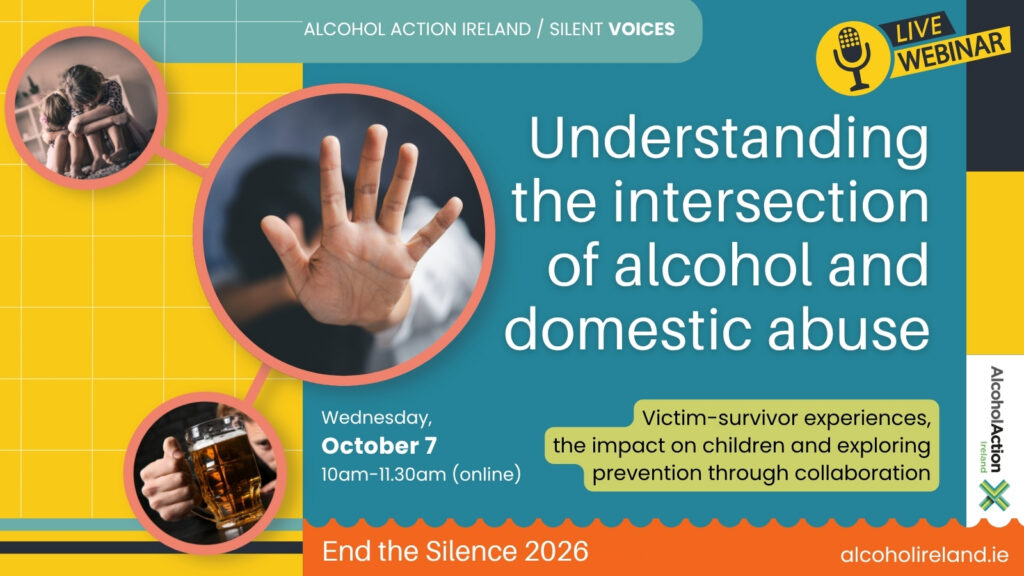
Webinar information
A free live webinar on victim-survivor experiences and challenges, the impact on children and exploring prevention through collaboration
Live webinar featuring presentations by:
- Jonathan Meddings, Policy and Engagement Manager at Monash Addiction Research Centre, Australia, and
- Charlotte Hazell-Caldwell, Head of Training & Development at the National Centre for Domestic Violence (NCDV)
Followed by a panel discussion including:
- Dr Michelle Walsh, CEO at Move Ireland
- Eileen Beamish, Founder, Director of Celtic Grace
—-
About the speakers:
Alcohol Change Victoria is a cross-sector coalition of leading organisations united in their calls for progress on tackling alcohol harms in Australia.
Jonathan Meddings, Policy and Engagement Manager at Monash Addiction Research Centre, Australia, will speak about the series of roundtable discussions carried out by Alcohol Change Victoria between May 2025 and May 2026, with leading researchers, lived experience experts, policy professionals, and service providers from the alcohol and other drug (AOD) and domestic, family, and sexual violence (DFSV) sectors.
These roundtables were thought-provoking and insightful, with many common themes coming out of the discussions. The work was intended as a conversation starter to orient future discussions, with the aim of working toward enhanced collaboration between the AOD and domestic, family, and sexual violence sectors to tackle violence by people who use alcohol.
This report reveals the complex interplay between alcohol and domestic, family and sexual violence and makes a series of recommendations to address this intersection.
See more here
In the UK, the National Centre for Domestic Violence (NCDV) analysed over 63,000 civil protection witness statements to share evidence-based insights into domestic abuse and use of alcohol. The aim was not to determine causation, but to understand how alcohol appears in lived experience, how it is described by applicants, and how it intersects with abusive behaviour.
Charlotte Hazell-Caldwell, Head of Training & Development at NCDV, will talk about how this dataset offers an unprecedented insight into the risks, patterns, and lived realities disclosed by victim survivors at the point of seeking legal protection. By examining recurring themes, including alcohol use, threats to kill, non-fatal strangulation, risks to children, child contact disputes, use of weapons, and other markers of coercive control, the aim was to translate survivor testimony into evidence that can inform policy, professional practice, and frontline response, with the commitment of turning real voices into shared insight, and insight into action.
See more here
Dr Michelle Walsh is CEO at Move Ireland. Move (Men Overcoming Violence) works in the area of domestic violence, with a primary aim of supporting the safety and wellbeing of women and their children who are experiencing, or have experienced violence/abuse in an intimate relationship. MOVE does this by facilitating men in a weekly group process that involves them taking responsibility for their violence and changing their attitude and behaviour.
Dr Walsh was recently elected to Council of Europe monitoring body on preventing and combatting violence against women, GREVIO. GREVIO is the body of independent experts responsible for monitoring the implementation by the parties of the Council of Europe Convention on preventing and combating violence against women and domestic violence, also known as the Istanbul Convention.
Dr Walsh brings more than 15 years’ experience in the field of domestic, sexual and gender-based violence (DSGBV). A fully accredited psychotherapist, clinical supervisor and trainer, her work spans programme delivery, applied research, policy development, and system evaluation, and is informed by engagement at both national and European level, including as a board member on the European Network for the Work with Perpetrators of Domestic Violence. Alongside her practice and policy work, Dr Walsh has contributed to professional training and higher education in the field of DSGBV.
Eileen Beamish is the founder and CEO of her own specialised wellbeing company
Www.celticgracemusic.co.uk/wellbeing
A multi-disciplinary scientist and former certified management consultant, Eileen is a multidisciplinary scientist and professional researcher by background.
She is also a Professional Coach & Mentor and Certified NLP Practitioner.
She is a professional harpist who uses music and language in therapeutic ways her trauma-informed wellbeing sessions.
Eileen is someone who brings lived experience to the conversation.
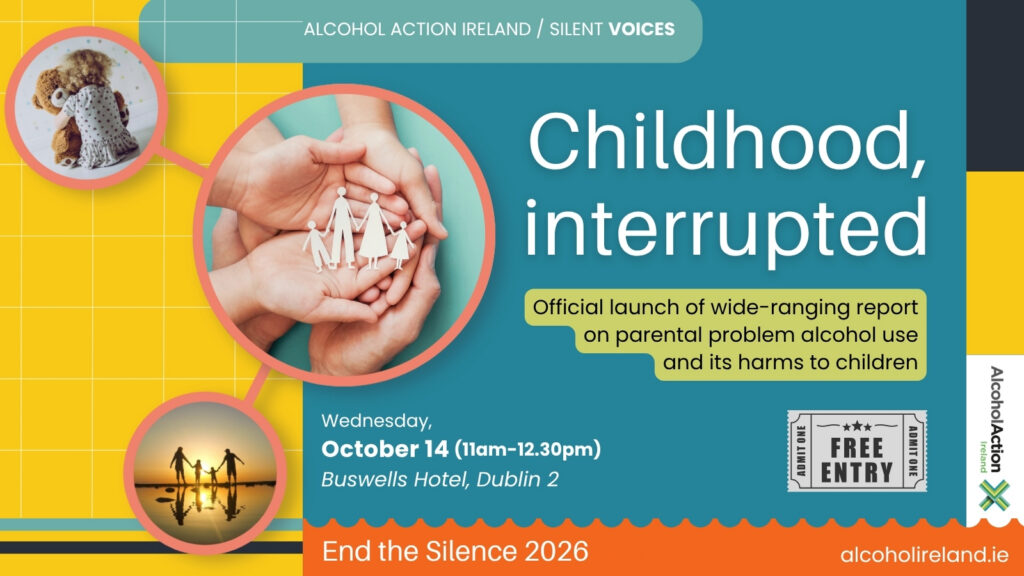
Event information
Official launch of wide-ranging AAI report on parental problem alcohol use and its harms to children.
Chaired by Ailbhe Smyth, this free event marks the launch of the latest report from Alcohol Action Ireland (AAI) through its Silent Voices initiative.
Joining AAI CEO Dr Sheila Gilheany in the discussion will be:
- Michael Hennessy, Service Delivery Manager at Move Ireland,
- Elizabeth Donlon Fox, ISPCC, National Coordinator for Childline and
- Maria O’Dwyer of Prevention and Early Intervention Network.
- Alan Cleere, manager of Rialto Community Drug Team
According to research from the Health Research Board, one third of children in Ireland have at least one parent who regularly binge drinks or is dependent on alcohol. Harmful alcohol use by a parent or caregiver has been shown to have a range of detrimental consequences for children, including negative health, educational, and social outcomes.
The seriousness of this is compounded due to the close connection between alcohol and crime and violence. With such high rates of hazardous and binge drinking, it is likely that hundreds of thousands of children are living in homes with alcohol-fuelled violence, with impacts that can devastate both childhoods and adulthoods and last a lifetime.
The experiences of children affected must be put to the forefront of policy making and the role of alcohol can no longer be ignored. There is a need for government coordination across multiple departments to recognise the role alcohol plays in devastating childhoods and respond with progressive policies to address it.
Alan Cleere is manager of the Rialto Community Drug Team, the oldest community drug team in the country, where he has been since 2014. Before that he worked in various youth and community services around the city.
The work of Hidden Harm began from the family support and systemic family therapy established in RCDT and from other voices within the Canal’s Task Force area. We applied out of an underspend that became available in the Task Force in 2024, and Alan set up this steering group who have led out in the development of the research and hopefully the future actions.
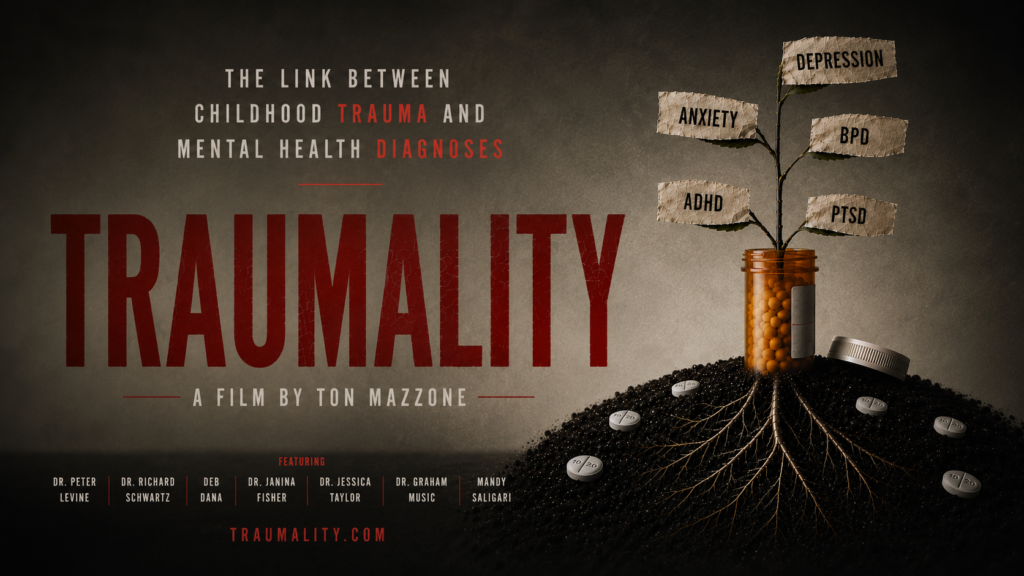
Event information
SOLD OUT
Irish premiere of feature-length documentary challenging the way we understand mental health. Followed by panel discussion and Q&A session.
Created by filmmaker Ton Mazzone, Traumality was born from his own lived experience of being failed by a mental health system that focused on diagnosis and symptom management, while rarely asking what had happened to the person behind the diagnosis.
Driven by a desire to better understand the root causes of psychological distress, Ton spent years researching the growing evidence linking childhood adversity, attachment, trauma and chronic stress to many of the mental health difficulties seen today. That journey became the foundation for Traumality.
Bringing together internationally recognised experts, researchers, clinicians and people with lived experience, the film explores childhood adversity (ACEs), attachment, the nervous system and the science of how trauma can shape both the mind and body. It also examines the limitations of a predominantly medical model of mental health, asking whether a greater understanding of trauma could transform the way we respond to distress.
More than an investigation into what’s wrong with the current system, Traumality explores what becomes possible when society adopts a trauma-informed approach. From healthcare and education to workplaces, communities and public services, the film presents a vision of a future that recognises the lasting impact of trauma, prioritises prevention and responds with compassion rather than judgement.
The result is a hopeful, evidence-led film inviting audiences to rethink mental health, challenge long-held assumptions and imagine a future where healing begins with understanding.
- Ton Mazzone is the writer, director, producer, cinematographer and editor of Traumality.
The film was born from Ton’s own experience of navigating the mental health system after years of living with anxiety, social anxiety and depression. Like many people, he was given diagnoses that explained what he was experiencing, but never why.
As therapy introduced him to trauma, attachment, the nervous system and the lasting impact of childhood adversity, his understanding of mental health changed completely. What he had believed were lifelong disorders began to make sense as understandable adaptations to earlier experiences.
Driven by a desire to better understand the evidence, Ton spent several years independently researching, filming and producing Traumality. The documentary brings together world-leading experts, clinicians, researchers and people with lived experience to explore the growing evidence linking trauma and adversity to many of the mental health challenges we see today.
Created entirely without funding or a production company, Traumality is both a personal journey and an independent investigation into one of the most important conversations in modern mental health.
Ton’s hope is that the film encourages curiosity, challenges long-held assumptions, and contributes to a future where more people are understood through a trauma-informed lens.
More at:
Webinar information
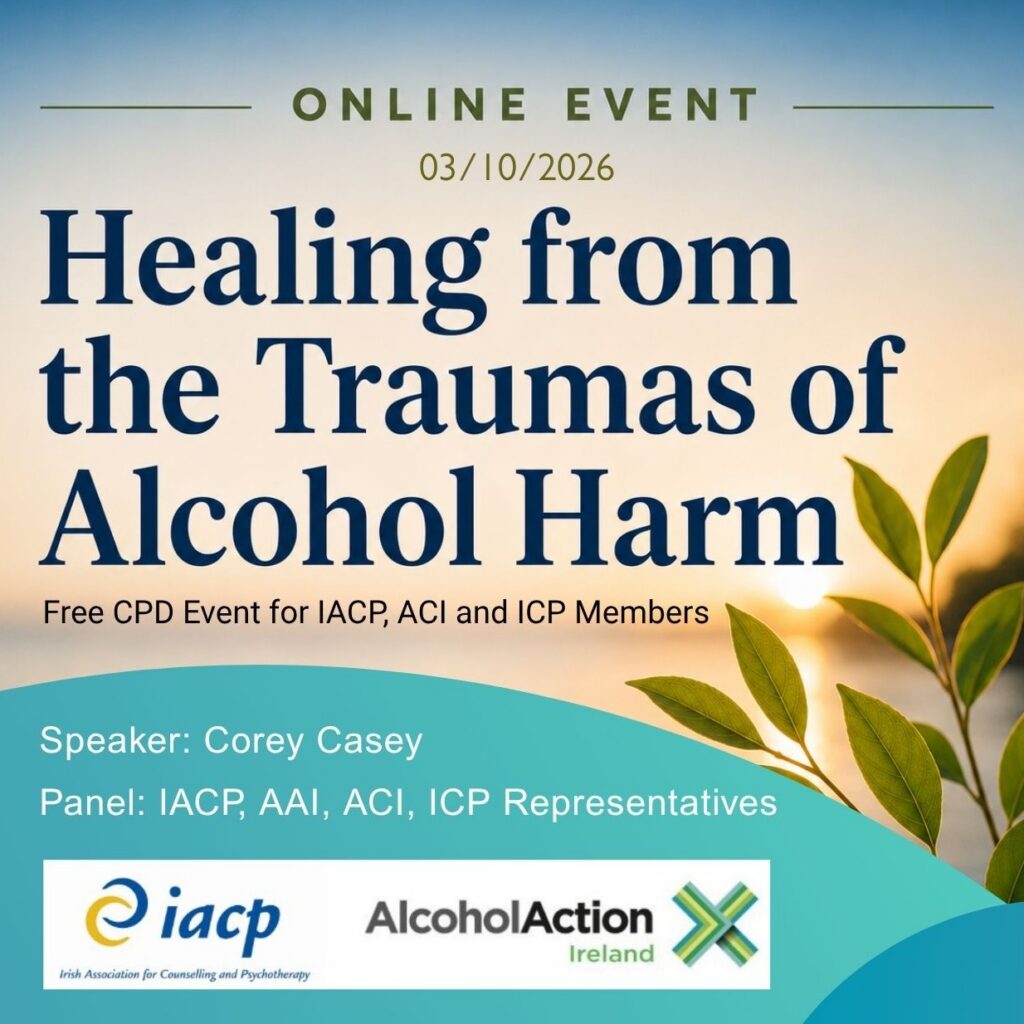
The webinar will bring together practitioners to explore supporting those affected by alcohol-related harm within the family.
Places are available for members of IACP, ICP and ACI. Please contact your organisation to register.