
Europe is the heaviest drinking region in the world, and Ireland consumes alcohol at a rate around the European average. According to Healthy Ireland survey data 71% of the population over the age of 15 consume alcohol[1] – using CSO population data we can therefore estimate that there are 3.2 million drinkers in Ireland. On average in 2025, each person in Ireland individually consumed 9.24 litres of pure alcohol also known as ethanol.
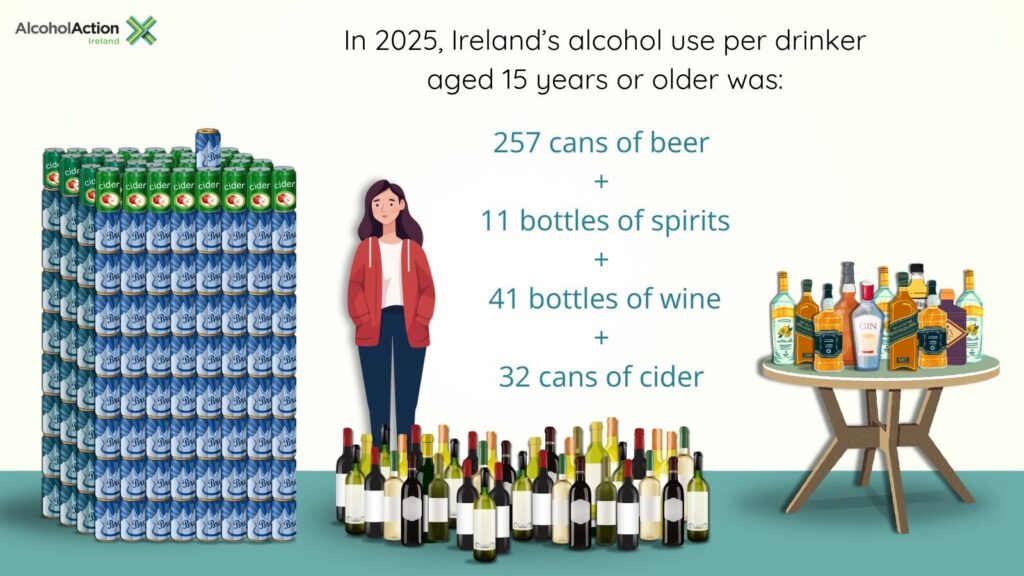
When we strip away those who don’t consume alcohol and focus on drinkers, we can see that each Irish drinker consumes 13 litres of pure alcohol, or ethanol, per year.[2] This translates into 257 cans of beer, 11 bottles of spirits, 41 bottles of wine, and 32 cans of cider for every drinker aged 15 years and older.
More worrying still is the nature of Ireland’s alcohol consumption. Ireland has the second highest level of binge drinking across the OECD,[3] while the Health Research Board (HRB) reports that binge drinking among low-to moderate-risk drinkers accounts for most alcohol-related harm in Ireland.[4] Indeed, the scale of harm from low-to moderate drinking was the standout finding of two recent reports from the Health Information and Quality Authority (HIQA) analysing Ireland’s current lower-risk alcohol guidelines.
Is alcohol risk free?
Alcohol is not a risk-free product, despite what the alcohol industry would like to you to think.
The simple fact is – alcohol is a regulated, toxic, and psychoactive substance of which there is no safe amount that does not affect health. In addition, alcohol’s broader risks include the social and economic harms which are a byproduct of its use.
| The physical and mental health impact of alcohol extends far beyond alcohol hangover – alcohol is found to play a causal role in more than 200 diseases, injuries and other health conditions[5] |
For the avoidance of doubt ethanol (C2H5OH), the intoxicating component of alcohol, is an industrial and laboratory chemical solvent. [6] This chemical, which is a central nervous system (CNS) depressant, is the intoxicating ingredient of the many alcoholic beverages people consume.[7] When you drink alcohol, your body metabolises it, or breaks it down, converting it from ethanol to a toxic chemical called acetaldehyde.[8] Naturally, consumption of such a chemical has physical and mental health risks beyond alcohol hangover. Therefore, the Health Service Executive issues guidelines on alcohol consumption and its risks and harms.
What are the risks and harms of alcohol?
Physical health
Alcohol is no ordinary commodity; it is a depressant drug with significant health implications for those who use it. Alcohol use is the seventh leading risk factor for both deaths and disability-adjusted life years globally, and the leading risk factor among those aged 15-49 years.[9] Yet alcohol is a modifiable risk factor; reductions in alcohol consumption would lead to an associated reduction in the burden of disease, not only from conditions such as alcohol dependence and alcohol related liver disease, but also from commonly reported health conditions, including obesity, cardiovascular disease, and cancer.[10] Moreover, alcohol also contributes toxic effects on several organs, as well as poisoning, injuries, and impairments in behaviour.[11]
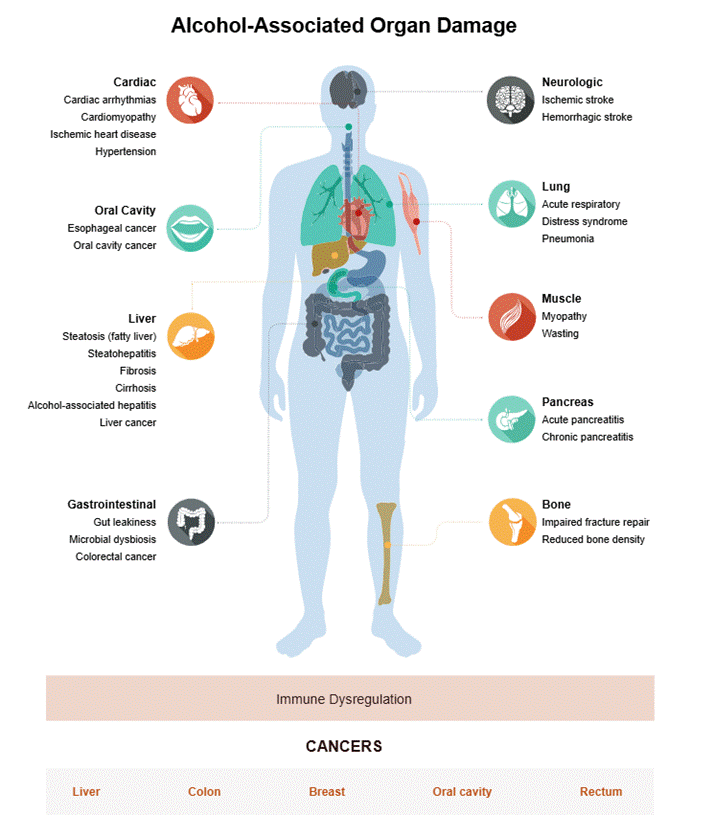
Alcohol Associated Organ Damage – US National Institute on Alcohol Abuse [12]
As outlined previously, Ireland has a high level of alcohol consumption, and many Irish people engage in harmful drinking patterns. With such high levels of use, there is an equally high health impact because most alcohol-attributable conditions show a dose-response relationship with volume of alcohol use – the more alcohol consumed, the higher the risk of disease and harm.
Mental health
Alcohol is no ordinary commodity; it is a depressant drug with significant health implications for those who use it, and it is a significant risk factor for suicide, as recognised by the World Health Organisation.[13] A psychotropic depressant of the central nervous system, alcohol promotes simultaneous changes in several neuronal pathways, exerting a profound neurological impact that leads to various behavioural and biological alterations.[14]
Alcohol has long been linked with poor mental health, including both self-harm and suicide.[15] Research has shown that alcohol consumption can affect mental health in multiple ways: it can be a contributory factor to mental health distress, an exacerbator of existing mental health difficulties, and mental health difficulties can in turn become a maintaining factor for continued alcohol consumption.
Globally, alcohol was associated with 27% of suicides and self-harm incidents in 2019, while in Ireland, alcohol was found to be a factor in nearly half of suicide cases[16] and one-third of self-harm hospital presentations in 2020.[17]
Because of these known risks of alcohol use, and the ever-emerging body of research outlining further risks, the Department of Health and the Health Service Executive advocate lower-risk guidelines aimed at reducing alcohol-related harm.
What are lower risk drinking guidelines?
Lower-risk alcohol guidelines provide information on levels of alcohol consumption associated with a lower risk to health outcomes, as well as circumstances in which alcohol should be avoided.[18]
The HSE issued the current Irish guidelines in 2015.
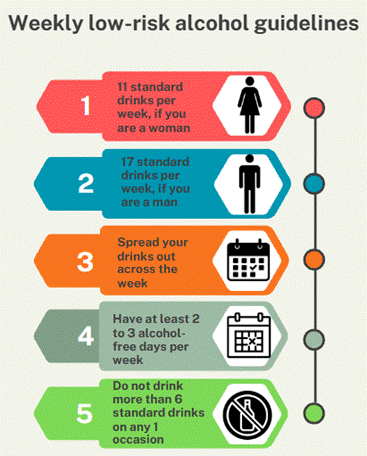
The guidelines also outline that the less you drink the lower your risk of developing alcohol-related health issues. In addition, the HSE website states “there is no level of alcohol use that is safe for health”.[19] However, this warning is not part of Ireland’s current lower-risk drinking guidelines.
As can be seen from the below table, Ireland’s lower risk drinking guidelines differs from other countries around Europe. Ireland’s guidelines are quite high and are particularly at odds with countries, such as Lativia and Lithuania, who have updated their advice to state that there is no level of alcohol consumption which is safe for your health.
| Country | Low-risk consumption | Alcohol content of a standard drink (g) |
| Belgium | Men: up to 21 drinks per week Women: up to 14 drinks per week | – |
| Bulgaria | Men: up to 15-16 g of alcohol per day Women: up to 8 g of alcohol per day | – |
| Czech Republic | Men up to 24 g of alcohol per day Women up to 16 g of alcohol per day Maximum 5 days a week | 16 g – 18 g |
| Denmark | Men and women: maximum 10 drinks per week No more than 4 drinks in one day Two alcohol-free days per week | 12 g |
| Germany | Men: maximum 2 standard units per day Women: maximum 1 standard unit per day At least 2 alcohol-free days per week | 10 g |
| Estonia | Men: up to 40 g of alcohol per day Women: up to 20g of alcohol per day At least 3 alcohol-free days | 10 g |
| Ireland | Men: 17 standard drinks spread out over the week Women: 11 standard drinks spread out over the week At least 2 alcohol free days | 10 g |
| Greece | Men: up to 2 glasses of wine or two drinks per day Women up to 1 glass of wine or one drink per day | 8 g (10ml) |
| Spain | Men: up to 20 g of alcohol per day Women: up to 10 g of alcohol per day | 10 g |
| France | Not more than 10 standard drinks per week Never more than 2 standard drinks per day At least one alcohol-free day per week | 10 g |
| Croatia | – | 10 g |
| Italy | Men: up to 2 units per day Women: up to 1 unit per day | 12 g |
| Cyprus | Men: up to 2 drinks per day; Women: up to 1 drink per day | |
| Latvia | Do not consume alcoholic beverages, as their consumption is harmful to your health | 12 g |
| Lithuania | Avoid consuming alcoholic beverages | 10 g |
| Luxembourg | Men: up to 2 drinks per day Women up to 1 drink per day 2 to 3 alcohol-free days per week | 12 g |
| Hungary | – | – |
| Malta | 18-21 years old: not more than 2 units per occasion, maximum twice a week Over 21: Men up to 21 units per week; women up to 14 units per week. Men and women: spread over 5 to 6 days | 8 g-10 g |
| Netherlands | Drink no alcohol or at least not more than one glass per day, men and women | 10 g |
| Austria | Men: up to 24 g of alcohol per day Women up to 16 g of alcohol per day Two alcohol-free days per week | 20 g |
| Poland | Men: up to 40 g of alcohol per day Women: up to 20 g of alcohol per day Maximum 5 days per week | 10 g |
| Portugal | Men: up to 24 g of alcohol per day Women: up to 16 g of alcohol per day | 10 g |
| Romania | Men: up to two drinks per day Women: up to one drink per day Drink in moderation | 12 g |
| Slovenia | Men: up to 2 dl of wine or one bottle (5dl) of beer or 2 shots of spirits per day for men (not more than 14 units per week and not more than 5 units per occasion) Women: up to 1 dL wine or half a bottle (2.5dl) of beer or one shot of spirits per day for women (not more than 7 units per week and not more than 3 units per occasion) At least 1-2 alcohol-free days per week. | 10 g |
| Slovakia | ||
| Finland | Men: on average no more than 2 standard drinks per day Women: on average no more than 1 standard drink per day | 12 g |
| Sweden | Men and Women: risky consumption is defined as more than 10 standard glasses per week or 4 standard glasses or more per drinking occasion once a month or more often | 12 g |
| United Kingdom | 14 units per week; spread over 3 or more days, and having some alcohol-free days | 8 g |
| Iceland | 12 g | |
| Norway | Men: up to 20 g of alcohol per day Women: up to 10 g per day Should not exceed 5 % energy intake | 12 g, 15 g |
| Switzerland | Men: 2-3 drinks per day Women: 1-2 drinks per day Two alcohol-free days per week | 10-12 g |
National low-risk drinking recommendations (or drinking guidelines) and standard units as of October 2024[20]
What is clear from the evidence is that when countries review their guidelines, they are typically revised downwards. For its part, Ireland’s guidelines have been in place since 2015, however, since then new evidence has emerged and international practice has advanced in using quantitative modelling to inform guideline development.[21] Resultantly, HIQA was commissioned by the Department of Health to undertake analysis to estimate the lifetime risk of alcohol-attributable mortality and years of life lost, and the relative rate of alcohol-attributable hospital admissions, in Ireland.[22]
Results of HIQA analysis
HIQA’s analysis was conducted to provide the necessary medical and scientific background to inform an update of Ireland’s national low-risk alcohol guidelines. For this, the Authority undertook two reports; first looking at the risk of death and admission to hospital due to alcohol consumption, while another report reviewed the international evidence on the association between alcohol consumption and mental health.
Modelling alcohol-attributable mortality risks and hospital admission rates in Ireland
In this research HIQA combined information on alcohol consumption, deaths, hospital admissions, and how alcohol affects the risk of particular health conditions.
The report found that the risk of death before age 75, death at any age, years of life lost, and the rate of hospital admissions all grew in line with increasing alcohol consumption.
For example, the report noted the following in relation to deaths from alcohol at different levels of consumption:
| Lifetime risk of death from alcohol | Males | Females | Beer | Wine | Spirits |
| 1 in 1,000 | 6g per day | 6g per day | Just under 1/3 of a pint | Just over half a small glass (60ml) | Just over half a pub measure |
| 1 in 100 | 13g per day | 12g per day | Around 2/3 of a pint | About one and a quarter small glass (120–130ml) | Around one and a quarter pub measures |
Typically, a half pint of beer, or a pub measure of spirits or a small glass of wine (100 ml) contains 10g of alcohol.
Therefore, HIQA concluded there is no safe level of alcohol consumption when it comes to mortality risk.
A systematic review on the association between alcohol consumption and mental health outcomes
In this research HIQA looked at 104 studies exploring if drinking alcohol led to depression, anxiety or suicidal thoughts. Because the studies were done in many different ways, HIQA found it hard to compare them and know for sure how what level of alcohol consumption alcohol affects mental health. However, HIQA noted that binge drinking is very common in Ireland, especially among young people, and much research has concluded that there is evidence that alcohol is often linked with worse mental health and is often involved in self-harm and suicide.[23]
Therefore, HIQA concluded that alcohol and mental health represent a significant and interconnected public health concern.[24]
Are the public fully aware of the risks of alcohol?
Beyond an understanding of the short-term risks of alcohol, such as the harm caused by alcohol hangover, it doesn’t appear that the Irish public are fully informed on the damage alcohol can do. Research by the HSE revealed that only 40% of the public are aware of the link between alcohol and cancer.[25] This is despite the fact that each year in Ireland there are approximately 1,000 alcohol related cancer cases. Indeed, the World Health Organisation estimates that 40% of cancers are preventable through making behaviour changes, and one such change is limiting alcohol intake as even small amounts can increase the risk of cancer.
Most significantly, perhaps, the public is poorly informed in relation to which drinkers account for the greatest level of health harm. It may come as a surprise to some, but the fact is that because low-moderate level drinkers make up a large proportion of the population, they account for a substantial share of overall alcohol harms and alcohol-related deaths.[26] This shows that alcohol harms extend well beyond heavy or dependent drinkers.
In addition, the rate of Fetal Alcohol Spectrum Disorders (FASD) in Ireland would further reinforce that the risks of alcohol are not fully understood – Ireland has the third highest rate of FASD in the world.[27] FASD are a group of disorders caused by prenatal alcohol exposure and are associated with a range of lifelong physical, mental, learning/educational, social, and behavioural difficulties.[28] FASD is caused by the consumption of any amount of alcohol at any time from 6 weeks before conception (either parent) and for the duration of the pregnancy. The symptoms of FASD may vary from child to child but are lifelong.[29]
However, a key reason the public are unaware of such risks is because of industry misinformation. Misinformation is an industry tactic. Just like the tobacco industry before it, the alcohol industry is adept at doing anything to protect its health-harming product – including denying the health risks associated with alcohol, opposing efforts to inform the public of these risks, and lobbying against public health measures aimed at reducing alcohol consumption and harm.[30] [31]
Despite the power and influence the industry wields, they resort to the tactic of misinformation because they need to obfuscate the harm their product causes at an individual level, a community level, and a national level. For instance, even 1-2 drinks per day carries increased cancer risk, with around 1,000 alcohol-related cancers diagnosed annually in Ireland, liver disease death rates have steadily increased over the past 20 years and Ireland has one of the highest rates of FASD in the world.[32] Additionally, at least 1,500 of hospital beds are in use daily[33] and up to 30% of Emergency Department presentations are caused by alcohol consumption.[34] It has devastating impacts on mental health with national research indicating that alcohol is a factor in nearly half of all suicides.[35] Tragically, we also know that four people lose their lives every single day because of alcohol.[36]
Misinformation, however, is not a victimless crime. Misinformation perpetuated by the alcohol industry has contributed to a dangerous gap in public awareness, because while the negative health effects of alcohol have for a long time been clear, many of the dangers of alcohol are still unknown to the public.
The need for alcohol health information labelling
One of the best ways to raise awareness of the risks of alcohol is alcohol health information labelling. Unsurprisingly, the alcohol industry does not want the public to know these risks and have fought tooth and nail against the introduction of alcohol labelling. Recently, the industry used EU-US trade difficulties in order to lobby for labelling to be postponed until 2028.
Alcohol health information labelling is essential to empower people to make an informed decision in relation to alcohol. The label warning of the dangers of alcohol consumption when pregnant, that alcohol causes fatal cancers, and that alcohol causes liver disease can give people some of the information they need to make the decision not to drink or to reduce their consumption.
Conclusion
The Department of Health and the HSE now have a choice to make in their approach to new lower-risk drinking guidelines. The evidence from the HIQA analysis is unambiguous:
- there is no safe level of alcohol consumption, and
- the scale of low-to-moderate drinking means this group accounts for the majority of alcohol-related deaths and illness.
HIQA’s findings make a compelling case for updating Ireland’s outdated 2015 guidelines, bringing them in line with the growing number of countries now unequivocally stating that no amount of alcohol is risk-free. A useful approach would also include information on the scale of risk at different consumption levels. This information must be conveyed to the public by the Department of Health and the HSE in the new guidelines. Through progressive, updated guidelines, and alcohol labelling in 2028, individuals can finally have the accurate, evidence-based information they need to make informed choices about their drinking and their health.
[1] Department of Health. (2025). Healthy Ireland survey 2025: Summary report. https://assets.gov.ie/static/documents/2b9f909b/Healthy_Ireland_Summary_Report_2025_Web_07.11.2025.pdf
[2] Alcohol Action Ireland. How much do we drink? Retrieved July 17, 2026, from https://alcoholireland.ie/facts-about-alcohol/how-much-do-we-drink/
[3] OECD. (2025). Health at a glance 2025: OECD indicators. OECD Publishing. https://doi.org/10.1787/8f9e3f98-en
[4] Health Research Board. (2019). New HRB study examines alcohol-related harms in Ireland. https://www.hrb.ie/news-stories/new-hrb-study-examines-alcohol-related-harms-in-ireland/
[5] World Health Organization. (2024). Alcohol. https://www.who.int/news-room/fact-sheets/detail/alcohol
[6] Encyclopaedia Britannica. (2026). Ethanol. In Encyclopædia Britannica. https://www.britannica.com/science/ethanol
[7] National Center for Biotechnology Information. (2026). PubChem compound summary for CID 702, Ethanol. Retrieved July 17, 2026, from https://pubchem.ncbi.nlm.nih.gov/compound/Ethanol
[8] National Cancer Institute. (2025). Alcohol and cancer risk fact sheet. U.S. Department of Health and Human Services, National Institutes of Health. https://www.cancer.gov/about-cancer/causes-prevention/risk/alcohol/alcohol-fact-sheet
[9] O’Dwyer, C., Mongan, D., Doyle, A., & Galvin, B. (2021). Alcohol consumption, alcohol-related harm and alcohol policy in Ireland (HRB Overview Series 11). Health Research Board. https://www.hrb.ie/wp-content/uploads/2024/06/HRB_Alcohol_Overview_Series_11.pdf
[10] O’Dwyer, C., Mongan, D., Doyle, A., & Galvin, B. (2021). Alcohol consumption, alcohol-related harm and alcohol policy in Ireland (HRB Overview Series 11). Health Research Board. https://www.hrb.ie/wp-content/uploads/2024/06/HRB_Alcohol_Overview_Series_11.pdf
[11] O’Dwyer, C., Mongan, D., Doyle, A., & Galvin, B. (2021). Alcohol consumption, alcohol-related harm and alcohol policy in Ireland (HRB Overview Series 11). Health Research Board. https://www.hrb.ie/wp-content/uploads/2024/06/HRB_Alcohol_Overview_Series_11.pdf
[12] National Institute on Alcohol Abuse and Alcoholism. (n.d.). Alcohol’s effects on the body. National Institutes of Health. https://www.niaaa.nih.gov/alcohols-effects-health/alcohols-effects-body
[13] World Health Organization. Preventing Suicide: A Global Imperative. (2014) . Available at: https://iris.who.int/bitstream/handle/10665/131056/9789241564878_eng.pdf?sequence=8
[14] Costardi JV, Nampo RA, Silva GL, Ribeiro MA, Stella HJ, Stella MB, Malheiros SV. A review on alcohol: from the central action mechanism to chemical dependency. Rev Assoc Med Bras (1992). 2015 Aug;61(4):381-7. Available at: https://pubmed.ncbi.nlm.nih.gov/26466222/
[15] Doyle, A., Mongan, D., Galvin, B. HRB Overview Series 13 Alcohol: availability, affordability, related harm, and policy in Ireland. Health Research Board. (2024). Available at: https://www.hrb.ie/wp-content/uploads/2024/06/HRB_Alcohol_Overview_Series_13.pdf
[16] Larkin, C., Griffin, E., Corcoran, P., McAuliffe, C., Perry, I.J., and Arensman. (2017) Alcohol Involvement in suicide and self-harm. Crisis, 38, (6), pp. 413-422. Available at: https://www.drugsandalcohol.ie/28375/
[17] Doyle, A., Mongan, D., Galvin, B. HRB Overview Series 13 Alcohol: availability, affordability, related harm, and policy in Ireland. Health Research Board. (2024). Available at: https://www.hrb.ie/wp-content/uploads/2024/06/HRB_Alcohol_Overview_Series_13.pdf
[18] Health Information and Quality Authority. (2026). Modelling alcohol-attributable mortality risks and hospital admission rates in Ireland. https://www.hiqa.ie/sites/default/files/2026-06/Modelling-Alcohol-Attributable-Mortality-Risks-and-Hospital-Admission-Rates-in-Ireland.pdf
[19] Health Service Executive. (2025). Weekly low-risk alcohol guidelines. https://www2.hse.ie/living-well/alcohol/health/improve-your-health/weekly-low-risk-alcohol-guidelines/
[20] European Commission. (2024). National low-risk drinking recommendations (or drinking guidelines) and standard units. Knowledge for Policy. https://knowledge4policy.ec.europa.eu/health-promotion-knowledge-gateway/national-low-risk-drinking-recommendations-drinking-guidelines_en
[21] Health Information and Quality Authority. (2026). Modelling alcohol-attributable mortality risks and hospital admission rates in Ireland. https://www.hiqa.ie/sites/default/files/2026-06/Modelling-Alcohol-Attributable-Mortality-Risks-and-Hospital-Admission-Rates-in-Ireland.pdf
[22] Health Information and Quality Authority. (2026). Modelling alcohol-attributable mortality risks and hospital admission rates in Ireland. https://www.hiqa.ie/sites/default/files/2026-06/Modelling-Alcohol-Attributable-Mortality-Risks-and-Hospital-Admission-Rates-in-Ireland.pdf
[23] Alcohol Action Ireland. (2024). Contribution to the review of “Connecting for Life”. https://www.drugsandalcohol.ie/43051/1/AAI_Submission-suicide-reduction-policy.pdf
[24] Health Information and Quality Authority. (2026). Plain language summary: A systematic review on the association between alcohol consumption and mental health outcomes. https://www.hiqa.ie/sites/default/files/2026-06/Plain-language-summary-Alcohol-and-Mental-Health-Review.pdf
[25] Health Service Executive. (2025). HSE aims to improve public knowledge that alcohol is a carcinogen that causes at least 7 types of cancer. https://about.hse.ie/news/hse-aims-to-improve-public-knowledge-that-alcohol-is-a-carcinogen-that-causes-at-least-7-types-of-cancer/
[26] Health Information and Quality Authority. (2026). Plain language summary: Modelling alcohol-attributable mortality risks and hospital admission rates in Ireland. https://www.hiqa.ie/sites/default/files/2026-06/Plain-language-summary-Alcohol-modelling.pdf
[27] Alcohol Action Ireland. (2025). Open letter: Alcohol health information labelling. https://alcoholireland.ie/take-action/ireland-must-stay-the-course-on-alcohol-labelling/open-letter-alcohol-health-information-labelling/
[28] Health Service Executive. (2026). New HSE campaign reminds us that the safest choice during pregnancy is no alcohol at all [Press release]. https://about.hse.ie/news/new-hse-campaign-reminds-us-that-through-all-the-mixed-messages-the-safest-choice-during-pregnancy-is-no-alcohol-at-all/
[29] Mayo Clinic. (2024). Fetal alcohol syndrome: Symptoms and causes. Mayo Clinic. https://www.mayoclinic.org/diseases-conditions/fetal-alcohol-syndrome/symptoms-causes/syc-20352901
[30] Commercial Determinants Research Group. (2024). Analysing the alcohol industry’s claims and use of evidence at the HoC Health and Social Care Committee Inquiry on Prevention in health and social care HC141 (6th February 2024) (PHS0623) [Written evidence submitted to the House of Commons Health and Social Care Committee]. UK Parliament. https://committees.parliament.uk/writtenevidence/128807/html/
[31] Dünnbier, M., Andersson, P., Sanchez, A., & Sperkova, K. (2025). From sports to screens: Exposing Big Alcohol’s predatory practices in 2024. Movendi International. https://movendi.ngo/wp-content/uploads/2025/01/BAE-Annual-Report-2024_final_web.pdf
[32] Alcohol Action Ireland. (2025). Open letter: Alcohol health information labelling. https://alcoholireland.ie/take-action/ireland-must-stay-the-course-on-alcohol-labelling/open-letter-alcohol-health-information-labelling/
[33] O’Dwyer, C., Mongan, D., Doyle, A., & Galvin, B. (2021). Alcohol consumption, alcohol-related harm and alcohol policy in Ireland (HRB Overview Series No. 11). Health Research Board. https://www.hrb.ie/wp-content/uploads/2024/06/HRB_Alcohol_Overview_Series_11.pdf
[34] McNicholl, B., Goggin, D., & O’Donovan, D. (2018). Alcohol-related presentations to emergency departments in Ireland: A descriptive prevalence study. BMJ Open, 8(5), Article e021932. https://doi.org/10.1136/bmjopen-2018-021932
[35] Larkin, C., Griffin, E., Corcoran, P., McAuliffe, C., Perry, I. J., & Arensman, E. (2017). Alcohol involvement in suicide and self-harm. Crisis, 38(6), 413–422. https://doi.org/10.1027/0227-5910/a000488
[36] Health Research Board. (2026). Alcohol statistics dashboard. HRB National Drugs Library. Retrieved July 17, 2026, from https://www.drugsandalcohol.ie/alcohol_statistics_dashboard

