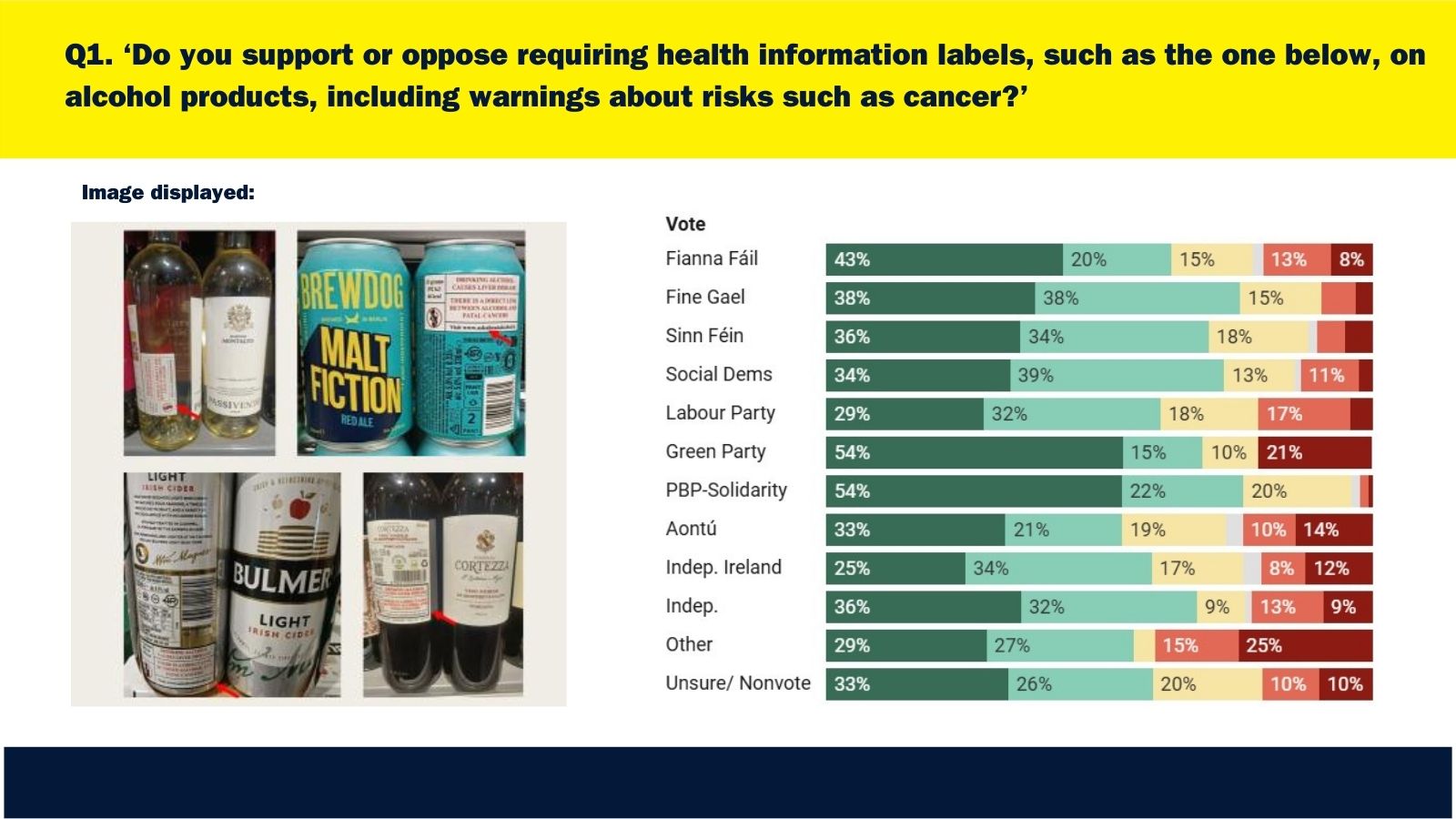
Polling data from Ireland Thinks, carried out on behalf of Alcohol Action Ireland, has found that two in three people support requiring health information labels on alcohol products, including warnings about risks such as cancer. With government last year having delayed labelling’s introduction until 2028, these findings hint at a government out of step with the will of the Irish people.
Of people who voted for government parties on the last General Election, 63% of Fianna Fail voters are in support of labelling. However, it is Fine Gael – whose ministers were the driving force behind the delay while party member Jennifer Carroll MacNeill is the Minister for Health – who seem to be most out of tune with their voters. More than three in four Fine Gael voters (76%) support labelling’s introduction, the most of any political party.
Recent comments attributed to Fine Gael’s Minister for Agriculture, Martin Heydon, by his Italian counterpart, Francesco Lollobrigida, that the Irish government has decided to abandon its plan to introduce labelling and that Ireland will instead allow Europe take control of this important national health policy also seem to fly in the face of the wishes of the Irish people. Three in five people polled believe that Ireland should proceed with its own alcohol health warning labels even if other EU countries do not do the same – this despite not being given the context that there is no harmonising EU legislation on the use of health warnings on alcohol beverages, and that previous attempts to view alcohol through a public health lens at EU level, such as the EU’s Beating Cancer Plan, were systematically weakened by the alcohol industry’s lobbying efforts.
Support for labelling was evenly spread among all age groups and regions, with more females in favour (73%) than males (59%).
The polling also shows more people than not oppose to the decision to delay labelling’s introduction. Without being given the context of the scale of the alcohol industry’s lobbying efforts to oppose labelling by peddling disinformation at every level of influence – local, national and international – two in five people (40%) are against the government’s decision, with almost an equal number (38%) neither supporting nor opposing it. Again, Fine Gael seem the most out of step with their voters, with 44% of FG voters against the decision to delay.
The alcohol industry’s opposition to any public health initiatives that seek to reduce consumption is ferocious and well-funded, with intense industry lobbying taking place ahead of the decision on labelling. In the first half of last year, in the lead-up to the delay, there were at least six meetings between alcohol industry representatives and senior government figures about labelling.
There is no doubt that because the government caved in on labelling already, the alcohol industry will come back with renewed vigour ahead of September 2028, the new introduction date for labelling. The results of this poll should give government something to reflect on that the Irish people, and government party voters in particular, want those in power to prioritise the health and wellbeing of Irish people ahead of private interests and introduce labelling. Failure to do so could result in punishment at the ballot box. Even more fundamentally, government capitulation undermines faith in the democratic process. If so, the dangers are not just to public health but also to public trust in government.

