Introduction
The alcohol industry is among the most active sectors seeking to influence policy and public opinion in Ireland. Its many parts, from producers and wholesalers to pubs and off-licences, share a common objective of maximising the volume of alcohol sold.
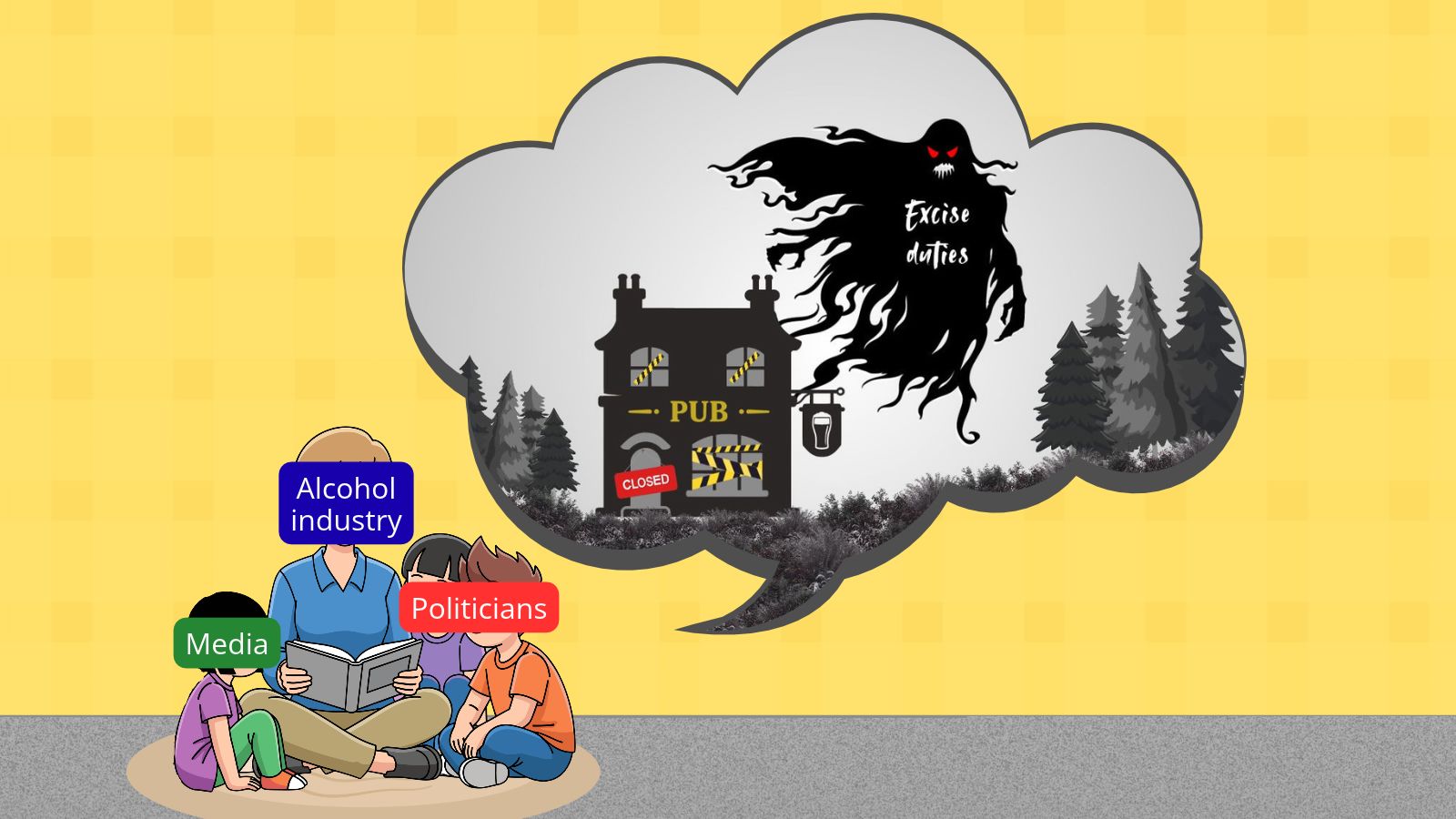
Recent lobbying around Budget 2027 shows how the industry presents that interest as a public good. Pub closures were among the most talked-about issues in the run-up to the Budget. Vintners argued that excise duty had made alcohol unaffordable, driving down trade and forcing pubs – rural pubs in particular – to close. Many politicians and much of the media accepted this scare story. However, the evidence does not support it.
In this blog, Alcohol Action Ireland looks past the industry’s claims to the realities that truly haunt Ireland’s rural pubs. These include the deregulation of off-licences, changing consumer behaviour, and population movement.
Excise
For several months, publicans across Ireland have pushed the narrative that excise duties on alcohol are responsible for pub closures. They have claimed that excise has made alcohol unaffordable, reducing trade and forcing pubs, particularly those in rural areas, to close. Politicians and much of the media have absorbed this argument. However, there is no evidence that excise has made alcohol in pubs unaffordable nor that it has contributed to pub closures.
There is no doubt that some rural pubs have closed over the last decade, but the reasons for this are multifaceted, such as population movement, changing consumer behaviour, and cannibalisation within the alcohol industry itself. None of this has anything to do with excise duties and the alcohol industry has admitted as much themselves.
Speaking on pub closures, the president of the Licensed Vintners Association (LVA) stated in a press release: “Rural pubs are closing because they don’t have a market. Their customer base is vanishing. New pubs aren’t going to appear in locations that aren’t commercially viable… One in five of this country’s pubs have vanished since 2005. The vast majority of those have been rural pubs. That is because as a country we are already overpubbed.”.[1]
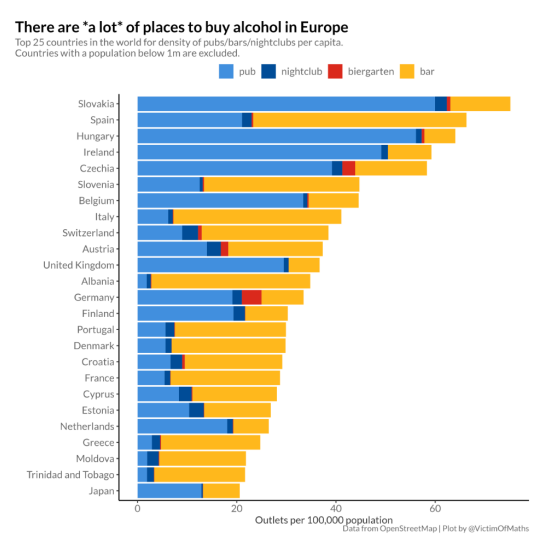
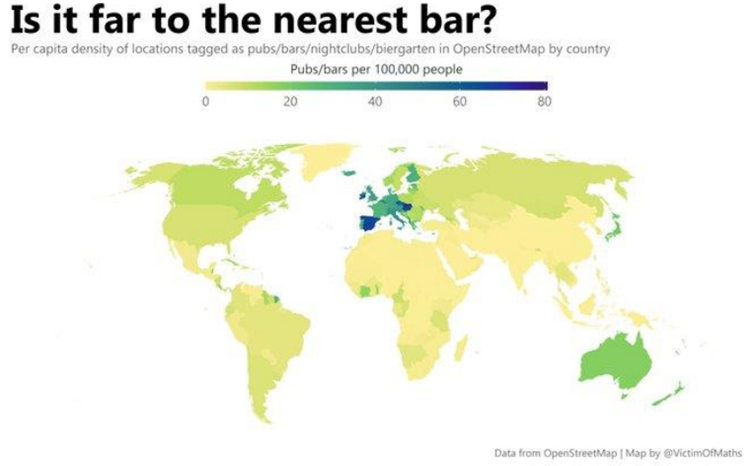
The analysis of the LVA is corroborated by research from the University of Sheffield. In a recent study researchers found that Ireland ranks third in the world for the number of pubs per capita,[2] and despite the number of reported closures, further research from Maynooth University and the Health Research Board (HRB) found there is 1 pub for every 684 adults nationally.[3] These studies also point to one of the core reasons for the decline in the rural pub trade – not excise duties, but competition from within the industry itself. Researchers found that the drop-off in rural pubs corresponds with an increase in off-licences.[4]
The impact of off-licence deregulation on rural pubs
At the heart of the decline of rural pubs lies the deregulation of the licensing system, a change driven by the alcohol industry and enacted by government. The pivotal step in this deregulation was the liberalisation of the off-licence trade in the early 2000s.[5] To understand its impact, it is first necessary to understand how alcohol licensing works.
A liquor licence is a permission to trade in alcohol. Subject to law, it gives the licensee the right to sell intoxicating liquor from their premises. Licences exist to regulate who may sell alcohol, where and how, which makes the licensing system one of the State’s principal tools for controlling the availability of alcohol.[6]
One of the foundational pieces of legislation in relation to modern liquor licensing in Ireland was the Licensing (Ireland) Act 1902, which introduced a general prohibition on new licences, applying to both on- and off-licences.[7] That position, however, changed dramatically with the deregulatory Intoxicating Liquor Act 2000.[8] This legislation, lobbied for by the alcohol industry and enacted by government, introduced the principle that a licence could be obtained by extinguishing another licence anywhere else in the State, effectively creating a national, tradeable market in licences, which currently trade for tens of thousands of euros.[9]
This was the pivotal moment of deregulation that created the conditions for the decline of rural pubs. It did so in two ways: first, by changing consumption habits, flooding the market with cheap, ubiquitously available alcohol that ate into pubs’ share of trade; and second, through the purchase of rural pub licences to open off-licences.
Indeed, the data reveals an industry eating itself and explains the difficulties facing rural pubs. Research from the HRB revealed a decrease in the number of pub licences (-20% over the 18-year period from 2003 to 2021) has been offset with a 95% increase in the number of off-licences in the same period.[10] This situation, however, was identified almost 20 years ago when one TD remarked of the impact of the 2000 Act – “The number of off-licences has trebled in the past seven years, and there is now one off-licence for every 750 adults with a total of 4,300… In the meantime, it is remarkable the traditional public house as we know it… has gone into serious decline and we have seen approximately 1,000 public houses close in the past three years.”.[11]
Indeed, such has been the growth of off-licences there is now a liquor licence for every 345 people nationally, with 75% of the population, or 3.88 million people, now living within 300 metres of a licenced premises.[12] This has fostered a shift towards drinking at home and shows how the off-trade has cannibalised the on-trade, particularly rural pubs.
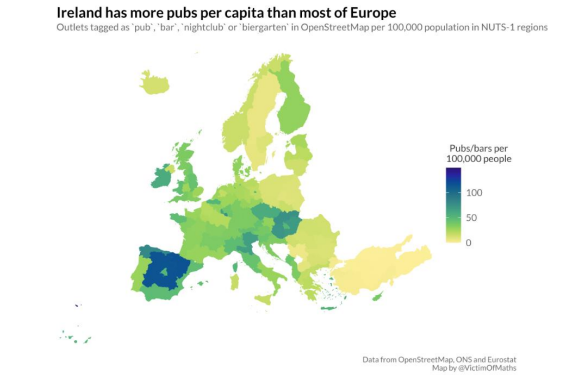
This is why blaming excise for the decline in pubs is not just untrue, but dangerous. Cutting excise will not undo the range of issues affecting the rural pub trade: Ireland being “overpubbed”, as the vintners themselves point out; population shifts; changing consumer behaviour; or the ubiquity of off-licences.
Furthermore, excise is responsible for less than 10% of the price of a pint, but its imposition reflects the specific harmful nature of alcohol as a product. Alcohol causes multiple illnesses and deaths, results in criminal justice costs, loss of productivity and plays a role in road collisions, amongst other harms. So much so that it is estimated, using WHO and OECD calculations, alcohol harm costs the State somewhere in the region of €14bn per year. Against that alcohol excise duties only raise €1.2bn annually.
Cutting excise will not solve their problems, which were created by government deregulation demanded by the alcohol industry itself. Unless government reintroduces tighter controls on the number of off-licences, or Minimum Unit Pricing for alcohol is increased to stem the flow of cheap off-licence alcohol into the market, the core issue will remain, and rural pubs will keep selling their licences, either for use as off-licences or urban pubs.
Licensed premises numbers – is Ireland an outlier?
Bars and pubs
Across Europe several countries have also seen a reduction in bars and pubs. Between 2002 and 2022, France lost 18,000 of its “bars-tabacs”.[13] [14] In Britain, more than a quarter of pubs have closed since 2000.[15] Similarly, in Flanders, Belgium, between 2013 and 2023, 2,739 cafés or bars shut their doors,[16] while over the same period a similar number of cafés closed in the Netherlands.[17] In neighbouring Germany, the most populus state, North Rhine-Westphalia, has seen almost half of all pub owners leave the trade, while in Brandenburg, in eastern Germany, some 70% of pubs have closed their doors over the last decade.[18]
Italy has seen a similar decline with more than 21,000 bars closing over the past ten years,[19] and Spain is no different with 26,830 bars closing since 2010.[20] Indeed, broader analysis of Eurostat data shows a decline in the number of pubs, bars, taverns, coffee shops, mobile beverage vendors and other beverage service activities[21] across the vast majority of European countries over several years.[22]
Interestingly, all the countries mentioned above have lower alcohol excise than Ireland, and yet they are experiencing similar levels of closures. This is because excise duties are not responsible for pub closures in Ireland, no more than they are responsible for pub closures anywhere. Consumer behaviour is one of the main reasons, but there are other reasons too – inflation; energy and fuel costs; increased wholesale costs from global producers such as Diageo, Heineken Holding N.V, and AB InBev; insurance; rent; sale of licences to off-licences; and developers evicting to reclaim properties, to name but a few issues affecting pubs, cafés, and clubs.[23] [24]
Nightclubs
Since 2000, over 500 nightclubs have closed their doors in Ireland.[25] However, the decline of nightclubs is not unique to this country and has been happening across Europe for some time. Analysis of closures across several European countries reveals a multitude of reasons for closures, such as property costs, changing patterns of youth socialisation and demographic change, rather than restrictions on opening hours. In Germany, the phenomenon of the decline of nightclubs has been dubbed Clubsterben – “the death of clubs” – and this has been particularly acute in major cities such as Berlin.[26]
In France, more than two thirds of nightclubs have closed for a multitude of reasons, including financial constraints and changing consumer behaviours. [27] An investigation by La Repubblica found that 2,100 nightclubs in Italy closed in the 14 years to 2024. Many of those sites have since become banks, city car parks, and offices.[28] The decline has been attributed both to demographic change and to shifting consumer behaviours. While in the United Kingdom, the Night Time Industries Association’s Night Time Economy Report 2024 recorded 67 venue closures in that year alone.
Is alcohol affordable in Ireland?
Research from Prof. Colin Angus at the University of Sheffield has examined the affordability of alcohol in Ireland, noting that while price is the actual cost of something, affordability is the extent to which a person or household can comfortably afford that cost.
That research shows that Ireland has the third-highest average annual full-time adjusted salary in the EU, and as such, alcohol is in fact very affordable.[29] Indeed, shop-bought alcohol today costs around the same as it did 20 years ago.[30] Taking inflation into account, as of 2024 off-licence-bought alcohol in Ireland is 85% more affordable than in 2003, while alcohol bought in the on-trade is 24% more affordable than it was two decades ago.[31]
Conclusion
Excise duties are not causing Ireland’s pubs to close. The decline of rural pubs has many causes, including population shifts, changing consumer behaviour, and an industry that has cannibalised itself. Between 2003 and 2021, pub licences fell by 20% while off-licences rose by 95%. Moreover, pubs and nightclubs are closing across Europe, in countries with lower excise than Ireland. Indeed, alcohol here is actually more affordable than it was two decades ago, so cutting excise would not resolve any of the issues which vintners have claimed is causing rural pubs to close.
OTHER BLOGS IN THIS SERIES:
From last orders to disorder: The impact of extended opening hours on community safety
[1] https://www.lva.ie/government-liberalisation-of-licences-will-lead-to-pubs-on-every-corner-in-major-towns-and-cities-while-more-rural-pubs-die-off-lva/
[2] Ireland ‘third in world’ for pubs per person, says HRB. (2024). RTÉ News. https://www.rte.ie/news/2024/0417/1443978-alcohol-ireland/
[3] Doyle, A., Mongan, D., & Galvin, B. (2024). Alcohol: Availability, affordability, related harm, and policy in Ireland (HRB Overview Series 13). Health Research Board. https://www.drugsandalcohol.ie/40465/1/HRB_Alcohol_Overview_Series_13.pdf
[4] Doyle, A., Mongan, D., & Galvin, B. (2024). Alcohol: Availability, affordability, related harm, and policy in Ireland (HRB Overview Series 13). Health Research Board. https://www.drugsandalcohol.ie/40465/1/HRB_Alcohol_Overview_Series_13.pdf
[5] Intoxicating Liquor Act 2000, No. 17 of 2000. (2000). https://www.irishstatutebook.ie/eli/2000/act/17/enacted/en/html
[6] Citizens Information. (2026, May 19). Alcohol and the law. https://www.citizensinformation.ie/en/justice/criminal-law/criminal-offences/alcohol-and-the-law/
[7] Licensing (Ireland) Act 1902, 2 Edw. 7, c. 18. (1902). https://www.irishstatutebook.ie/eli/1902/act/18/enacted/en/html
[8] Intoxicating Liquor Act 2000, No. 17 of 2000. (2000). https://www.irishstatutebook.ie/eli/2000/act/17/enacted/en/html
[9] Intoxicating Liquor Act 2000, No. 17 of 2000. (2000). https://www.irishstatutebook.ie/eli/2000/act/17/enacted/en/html
[10] Doyle, A., Mongan, D., & Galvin, B. (2024). Alcohol: Availability, affordability, related harm, and policy in Ireland (HRB Overview Series 13). Health Research Board. https://www.drugsandalcohol.ie/40465/1/HRB_Alcohol_Overview_Series_13.pdf
[11] Dáil Éireann. (2008, June 24). Intoxicating Liquor Bill 2008: Second Stage (Vol. 657, No. 3). Houses of the Oireachtas. https://www.oireachtas.ie/en/debates/debate/dail/2008-06-24/31/
[12] Doyle, A., Mongan, D., & Galvin, B. (2024). Alcohol: Availability, affordability, related harm, and policy in Ireland (HRB Overview Series 13). Health Research Board. https://www.drugsandalcohol.ie/40465/1/HRB_Alcohol_Overview_Series_13.pdf
[13] La disparition des bars-tabacs, lieux de sociabilité, nourrit la progression du vote RN, selon une étude [The disappearance of bars-tabacs, places of sociability, is fuelling the rise of the RN vote, according to a study]. (2026, February 2). Le Monde. https://www.lemonde.fr/societe/article/2026/02/02/la-disparition-des-bars-tabacs-lieux-de-sociabilite-nourrit-la-progression-du-vote-rn-selon-une-etude_6665042_3224.html
[14] The demise of the French ‘tabac’: How bar closures are fuelling Le Pen’s far right. (2026, February 7). France 24. https://www.france24.com/en/france/20260207-france-how-bar-tabac-closures-are-fuelling-le-pen-far-right-pubs
[15] Thurnell-Read, T., & Deakin, R. (2025, July 16). More than a quarter of British pubs have closed since 2000. Here’s why. The Independent. https://www.independent.co.uk/news/uk/home-news/pubs-closed-uk-beer-british-cost-b2789934.html
[16] Torre Hovelson, V. (2025, October 4). Iconic bar and nightclub shuts its doors amid wave of closures in Flanders. The Brussels Times. https://www.brusselstimes.com/1773910/iconic-bar-and-nightclub-shuts-its-doors-amid-wave-of-closures-in-flanders
[17] ANP. (2026, January 27). Number of cafés in Netherlands continues to decline as Gen Z tends toward coffee bars. NL Times. https://nltimes.nl/2026/01/27/number-cafes-netherlands-continues-decline-gen-z-tends-toward-coffee-bars
[18] Döring, S. (2025, December 23). As Germans drink alone at home, community pubs are closing (J. Damphouse, Trans.). Jacobin. https://jacobin.com/2025/12/german-pub-bar-closures
[19] WineNews. (2025, October 21). Bar italiani in crisi: oltre 21.000 chiusure in 10 anni, urge un nuovo modello di business [Italian bars in crisis: Over 21,000 closures in 10 years, a new business model is urgently needed]. https://winenews.it/it/bar-italiani-in-crisi-oltre-21-000-chiusure-in-10-anni-urge-un-nuovo-modello-di-business_572142/
[20] aulkner, C. (2023, May 5). Are Spain’s traditional bars in danger? The Local Spain. https://www.thelocal.es/20230505/are-spains-traditional-bars-in-danger
[21] Eurostat. (n.d.). Enterprises by detailed NACE Rev.2 activity and special aggregates (sbs_ovw_act) [Data set]. Retrieved November 6, 2026, from https://ec.europa.eu/eurostat/databrowser/view/sbs_ovw_act/default/table?lang=en
[22] Eurostat. (n.d.). Enterprise statistics by size class and NACE Rev.2 activity (from 2021 onwards) (sbs_sc_ovw) [Data set]. Retrieved November 6, 2026, from https://ec.europa.eu/eurostat/databrowser/view/sbs_sc_ovw/default/table?lang=en
[23] Döring, S. (2025, December 23). As Germans drink alone at home, community pubs are closing (J. Damphouse, Trans.). Jacobin. https://jacobin.com/2025/12/german-pub-bar-closures
[24] https://www.theguardian.com/world/2026/may/31/germany-nightlife-scene-reclassify-clubs-berlin
[25] Power, C., & Sharpe, S. (2025). The rhythm of the night: Irish nightclub report. Give Us The Night. https://www.giveusthenight.com/wp-content/uploads/2025/06/TheRhythmOfTheNight_Irish-Nightclub-Report_GiveUsTheNight_2025.pdf
[26] Connolly, K. (2026, May 31). Germany’s embattled nightlife scene welcomes plan to reclassify clubs. The Guardian. https://www.theguardian.com/world/2026/may/31/germany-nightlife-scene-reclassify-clubs-berlin
[27] Chazan, D. (2025, August 10). French nightclubs close as youth stay at home. The Times. https://www.thetimes.com/world/europe/article/french-nightclubs-close-as-youth-stay-at-home-hnbsgdd9h
[28] NSS Magazine. (2024, May 21). Why more and more clubs are closing down: Since the 1990s, Italian clubs have decreased by 52%. https://www.nssmag.com/en/lifestyle/36756/italian-clubs-closing-trend
[29] Angus, C. (2025). Updated analysis of changes in alcohol sales, prices, taxation and affordability in the Republic of Ireland [Report]. University of Sheffield. https://doi.org/10.15131/shef.data.28323830
[30] Angus, C. (2025). Updated analysis of changes in alcohol sales, prices, taxation and affordability in the Republic of Ireland [Report]. University of Sheffield. https://doi.org/10.15131/shef.data.28323830
[31] Angus, C. (2025). Updated analysis of changes in alcohol sales, prices, taxation and affordability in the Republic of Ireland [Report]. University of Sheffield. https://doi.org/10.15131/shef.data.28323830

