Alcohol, children & young people
Youth drinking back at crisis levels
As outlined in our strategic plan, Alcohol Action Ireland believes that all young people are entitled to a childhood free from alcohol harm, and that protecting children from harm is not just a public health issue but a human rights one.[i]
Unfortunately, in recent years, after a decline from the mid-2000s to mid-2010s, youth drinking has surged back to crisis levels:
- Consumption among 15-24-year-olds rose from 66% in 2018 [ii] to 78% in 2025, [iii] approaching the early 2000s peak,[iv] when youth drinking was considered a national crisis;
- Young people are now the largest alcohol-consuming age group in Ireland;[v]
- 64% of young drinkers regularly binge drink;[vi] and,
- 1 in 3 young drinkers has an Alcohol Use Disorder.[vii]
Alcohol is the most commonly used substance among young people in Europe and is typically the first substance used by children in Ireland. Worryingly, when drinking begins at a young age, it is consistently associated with hazardous consumption patterns and significantly increases the risk of later dependency.[viii]
Protecting children
To protect children and young people from direct and indirect alcohol harm government policy must be multifaceted, agile, and evidence based. Naturally this means having bespoke and population-based alcohol policy to protect them from the direct harm associated with drinking, but policy must also protect children and young people from the indirect harms caused by other people’s drinking.
Firstly, children and young people, as well as the unborn, must be protected from the impact of alcohol-related harms that include issues such as:
- Drinking during pregnancy can harm the unborn and cause Foetal Alcohol Spectrum Disorders (FASD). These are a group of disorders caused by prenatal alcohol exposure and are associated with a range of lifelong physical, mental, learning/educational, social, and behavioural difficulties.[ix] Ireland is estimated to have the third highest prevalence of Foetal Alcohol Spectrum Disorder (FASD) in the world.[x]
- In Ireland, an estimated 1 in 6 young people are impacted by parental problem alcohol use, an adverse childhood experience that can have lasting impacts into adulthood.[xi]
- Every year in Ireland, tens of thousands of children start drinking.[xii] Starting to drink alcohol as a child, which is the norm rather than the exception in Ireland, is more likely to lead to heavy episodic drinking and is a known risk factor for later dependency.
- Children and young people have the highest levels of binge drinking of any age cohort in Ireland,[xiii] and have the fifth highest weekly alcohol consumption rates in the EU.[xiv]
Foetal Alcohol Spectrum Disorders (FASD)
Foetal Alcohol Spectrum Disorders (FASD) are a group of disorders caused by prenatal alcohol exposure and are associated with a range of lifelong physical, mental, learning/educational, social, and behavioural difficulties.[xv] FASD comprise Foetal Alcohol Syndrome (FAS), partial Foetal Alcohol Syndrome, Alcohol Related Birth Defects, and DSM-5 Neurodevelopmental Disorder – Prenatal alcohol exposure.[xvi] The symptoms of FASD may vary from child to child but are lifelong.[xvii]
FASD is caused by the consumption of any amount of alcohol at any time from 6 weeks before conception (either parent) or for the duration of the pregnancy. Alcohol is a teratogen, a substance that negatively affects the embryo and foetus during pregnancy.[xviii] Alcohol has an adverse effect on the developing brain, and on body organs, and the greater the amount of alcohol that has been consumed during pregnancy, the greater the risk to the development of the embryo and foetus.
Tragically, Ireland has the third highest level of FASD in the world, possibly affecting up to 7.4% of the population as highlighted by the HSE.[xix] The best available evidence estimates that about 600 Irish babies are born each year with Foetal Alcohol Syndrome (FAS), with a further 9-10 times this number of babies born annually who have other Foetal Alcohol Spectrum Disorders.[xx] This means that up to 15 babies a day are being born with FASD.
Parental Problem Alcohol Use
Growing up in a home with parental problem alcohol use (PPAU) has been recognised internationally as an adverse childhood experience (ACE)[xxi] for over 20 years, and the negative physical and mental consequences of this have been well established.[xxii]
In Ireland, at least 1 in 6 young people suffer the unnecessary impact of alcohol-related harms at home. Therefore, it is likely that today more than 200,000 children in Ireland are living with the traumatic circumstances of a childhood where parental problem alcohol use is a frequent event.
Furthermore, comprehensive research analysing the occurrence and co-occurrence of ACEs and their relationship to mental health in the United States and Ireland found that 1 in 4 Irish people may have grown up in a household blighted by alcohol. [xxiii] Including the other carer in the household, this means there may be over 1.5m people across all age ranges in Ireland have been affected by problem alcohol use in the home.[xxiv]
Unfortunately, research shows that living with PPAU can increase the risk for other ACEs, including neglect (both physical and emotional), abuse (emotional, physical, and/ or sexual), parental mental health issues, parental separation, divorce, or early death of a parent.[xxv]
The only way to tackle PPAU and its harms to children is to identify it, talk about it, offer services and support to those affected – especially children, and to limit its frequency by reducing alcohol consumption at a population level. This, however, will take a coordinated, whole-of-government response, which places the reduction of alcohol and its harms to children at the heart of government policy.
Silent Voices, an initiative of Alcohol Action Ireland, seeks to highlight the harm caused by PPAU and its impact across the lifespan.
Marketing to young people
Alcohol is one of the most heavily marketed products in the world with estimates on annual spending ranging from $7.7bn to $17.7bn.[xxvii] [xxviii] In Ireland, the annual spend on marketing alcohol to the public was conservatively estimated to be €115m in 2021.[xxix]
The purpose of marketing is clear – it is to create a need or desire for a product. When it comes to alcohol this is most interesting because alcohol is not a staple, it is not a necessary purchase, therefore a market must be created for it – and new drinkers must be recruited to create, sustain, and expand that market.[xxx] We have known for some time alcohol advertising seeks to recruit new drinkers and increase sales among existing consumers of alcohol, including young people and children, as well those with alcohol use disorder and dependency.[xxxi]
That’s why the role of alcohol marketing in encouraging, normalising, and glamourising alcohol consumption among young people cannot be underestimated. The international literature is clear – the greater the level of exposure to, or engagement with, alcohol marketing, the more likely young people are to drink alcohol.[xxxii]
Research commissioned by Alcohol Action Ireland and carried out by the Health Promotion Research Centre in NUI Galway found that Irish children are exposed to large volumes of alcohol marketing, which increases their likelihood of drinking alcohol and engaging in risky drinking behaviour.[xxxiii]
Ireland’s Public Health (Alcohol) Act (PHAA) contains provisions to restrict alcohol advertising to young people. While these moderate measures are helpful, they also fail to protect children in the main space inhabit – online.[xxxiv] Therefore, it is little wonder that research revealed Diageo, the multinational alcoholic beverage company, to be the number four advertiser to children in Ireland.[xxxv]
The advertising landscape has changed dramatically since the turn of the century and has been marked by a shift towards digital media and social media marketing. The widespread adoption of digital technologies and online social networks has revolutionised the way marketers engage with consumers.[xxxvi] While this has brought many benefits for businesses and customers, it has also brought new, and ever evolving, issues. This is especially true in relation to child protection in the online space, especially the digital and social media marketing of harmful products, such as alcohol, to children and teenagers.
The reason this is of such concern is because results from research and systematic reviews show a significant association between exposure to alcohol advertisements and drinking intentions, attitudes, and behaviours, particularly among children and adolescents. It is within this context that we must view the recent surge in youth drinking in Ireland over the past decade.[xxxvii]
Furthermore, a lacuna in the law has allowed alcohol companies to use zero-alcohol products, with identical branding to the master brand, to circumvent the PHAA. The alcohol industry’s three-pronged use of 0.0 alcohol products, as a tactic to circumvent the child protection provisions contained in the Public Health (Alcohol) Act 2018 (PHAA), as a means of boosting brand recognition and sales of the alcohol main brand, and a way of displacing soft-drinks, means that children and young people are being saturated in a sea alcohol advertising.
Despite representing a little over 1% of the total alcohol market, 0.0 alcohol products have been subject to aggressive advertising, with major brands using identical branding to their full-strength counterparts in spaces where alcohol advertising is otherwise restricted by the PHAA. This is exactly what the PHAA was supposed to protect against, especially in terms of alcohol advertising being seen by children, because evidence shows that exposure to alcohol marketing encourages children to drink at an earlier age and in greater quantities than they otherwise would.[xxxviii]
Youth drinking
There have been improvements in some respects in relation to youth drinking, including an increase in the average age at which young people start drinking and an improvement in Ireland’s position compared with EU averages.
Unfortunately, in recent years a narrative has emerged, propagated by the alcohol industry, that youth drinking is perhaps no longer an issue in Ireland. However, the data shows that youth alcohol consumption has surged in the last decade with little or no political or media scrutiny of this trend or its impact. A close analysis of the facts indicates that alcohol remains Ireland’s largest drug problem both for young people and the wider population, with significant health impacts such as rising levels of alcohol-related hospitalisations among young people and half of young driver fatalities having an alcohol component.
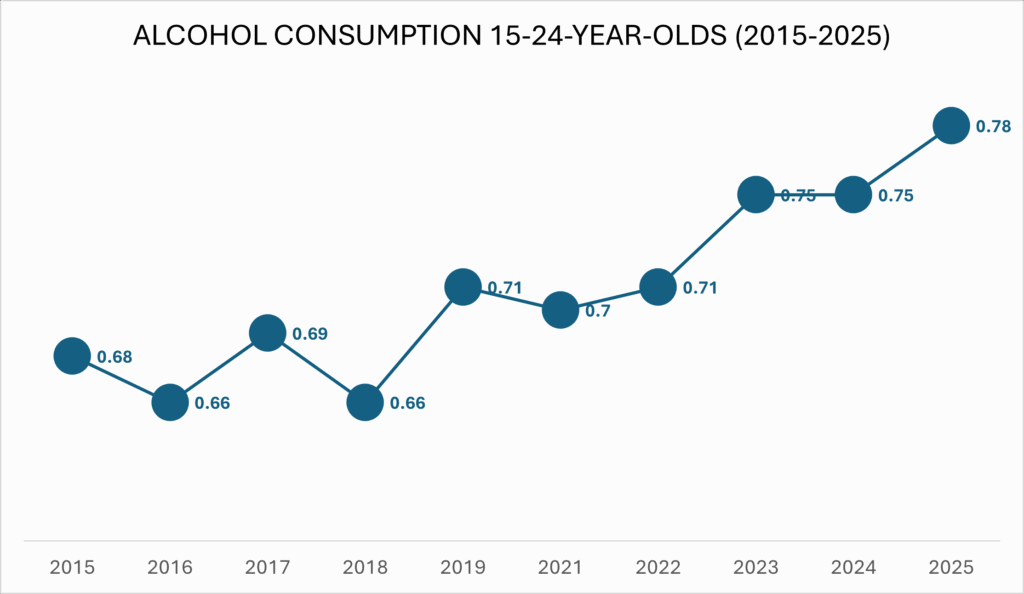
Above: Alcohol consumption amongst 15–24-year-olds (2015-2025) as recorded by Healthy Ireland Survey’s. NB. In 2019 Healthy Ireland data on alcohol was collected through the National Drug and Alcohol Survey, while in 2020 the Healthy Ireland Survey was cancelled due to Covid19.[xxxix][xl][xli][xlii][xliii][xliv][xlv][xlvi][xlvii][xlviii]
While drinking among young people declined from the mid-2000s to the mid-2010s, since 2015, that downward trend has reversed with consumption by 15–24-year-olds increasing from 66% in 2016[xlix] to 78% in 2025.[l] As previously outlined, starting to drink alcohol as a child is more likely to lead to heavy episodic drinking and is a known risk factor for later dependency. Therefore, it is little wonder that hazardous drinking is found to be commonplace (64%) among those aged 15–24 years,[li] binge drinking stands at 38%, and one in three young drinkers has an alcohol use disorder – almost 260,000 young people.[lii] [liii]
Therefore, stronger interventions, particularly those tailored towards younger individuals, are needed to reduce the substantial harms attributable to alcohol in Ireland.[liv]
Recommendations
- The Public Health (Alcohol) Act 2018 must be implemented in full – including the rollout of alcohol health information labelling from its delayed date of 2028.
- Minimum Unit Pricing must be uprated in line with the Consumer Price Index so as to maintain its public health value.
- The lacuna in the law which allows advertising of zero-alcohol products, using the identical branding of the master brand alcohol product, must be closed.
- There needs to be coherent policy across government with, for example, increases in excise duties annually in line with inflation, no increases in licensing hours and venues, plus enforcement of existing legislation on drink driving and the serving of alcohol to minors and those intoxicated.
- The Department of Justice must begin data collection around home deliveries of alcohol, ensure enforcement of the law, and develop legislation to close the lacunas in the law which allow minors access alcohol through home delivery services.
- A new target to reduce alcohol consumption to within the HSE lower-risk drinking guidelines should be set – 6.1 litres per capita.
- Regulation around social media and video sharing platforms needs to shift from “remove harm when you find it” to “prove that your system prevents harm” which must include alcohol marketing to young people.
- Treatment services must be improved and increased and must also be properly included in the new National Drugs Strategy, with the strategy reflecting that it is Ireland’s largest problem drug.
[i] Alcohol Action Ireland. (2024). Strategic plan 2025–2029. https://alcoholireland.ie/wp-content/uploads/2024/12/Strategic-Plan-Final-Updated.pdf
[ii] Department of Health. (2018). Healthy Ireland Survey 2018: Summary of findings (Ipsos MRBI). Government of Ireland. https://assets.gov.ie/static/documents/healthy-ireland-survey-summary-report-2018-d08308c6-c790-458f-afc2-f3f8c288e64b.pdf
[iii] Department of Health. (2025). Healthy Ireland survey 2025: Summary report. Department of Health. https://assets.gov.ie/static/documents/2b9f909b/Healthy_Ireland_Summary_Report_2025_Web_07.11.2025.pdf
[iv] Department of Health. (2026). Draft national drugs strategy 2026–2030: An integrated, equitable and evidence-based response to drug and harmful alcohol use. Department of Health. https://assets.gov.ie/static/documents/d10a6a59/Draft_National_Drugs_Strategy_2026_-_2030.pdf
[v] Department of Health. (2025). Healthy Ireland survey 2025: Summary report. Department of Health. https://assets.gov.ie/static/documents/2b9f909b/Healthy_Ireland_Summary_Report_2025_Web_07.11.2025.pdf
[vi] Drugnet Ireland. (2022). Overview of alcohol and other drug use among children and young people in Ireland. Issue 82 | Summer 2022. Dublin: Health Research Board. Available at: https://www.drugsandalcohol.ie/37095/1/Drugnet_Ireland_Issue_82.pdf
[vii] Drugnet Ireland. (2022). Overview of alcohol and other drug use among children and young people in Ireland. Issue 82 | Summer 2022. Dublin: Health Research Board. Available at: https://www.drugsandalcohol.ie/37095/1/Drugnet_Ireland_Issue_82.pdf
[viii] de Goede, J., van der Mark-Reeuwijk, K. G., Braun, K. P., le Cessie, S., Durston, S., Engels, R. C. M. E., Goudriaan, A. E., Moons, K. G. M., Vollebergh, W. A. M., de Vries, T. J., Wiers, R. W., & Oosterlaan, J. (2021). Alcohol and Brain Development in Adolescents and Young Adults: A Systematic Review of the Literature and Advisory Report of the Health Council of the Netherlands. Advances in nutrition (Bethesda, Md.), 12(4), 1379–1410. Available at: https://pubmed.ncbi.nlm.nih.gov/33530096/
[ix] Health Service Executive. (2026, May 18). New HSE campaign reminds us that the safest choice during pregnancy is no alcohol at all. HSE About. https://about.hse.ie/news/new-hse-campaign-reminds-us-that-through-all-the-mixed-messages-the-safest-choice-during-pregnancy-is-no-alcohol-at-all/
[x] Lange, S., Probst, C., Gmel, G., Rehm, J., Burd, L., & Popova, S. (2017). Global prevalence of fetal alcohol spectrum disorder among children and youth: A systematic review and meta-analysis. JAMA Pediatrics, 171(10), 948–956. https://doi.org/10.1001/jamapediatrics.2017.1919
[xi] Health Service Executive. (2018, April 16). HSE report reveals the untold story of the harms caused by other people’s drinking in Ireland [Press release]. HRB National Drugs Library. https://www.drugsandalcohol.ie/28840/
[xii] Find new source
[xiii] Department of Health. (2025). Healthy Ireland survey 2025: Summary report. Department of Health. https://assets.gov.ie/static/documents/2b9f909b/Healthy_Ireland_Summary_Report_2025_Web_07.11.2025.pdf
[xiv] Eurostat. (2019). Frequency of alcohol consumption by sex, age and educational attainment level [Dataset; hlth_ehis_al1e]. European Commission. https://ec.europa.eu/eurostat/databrowser/view/hlth_ehis_al1e__custom_17464485/default/bar?lang=en
[xv] Health Service Executive. (2026, May 18). New HSE campaign reminds us that the safest choice during pregnancy is no alcohol at all. HSE About. https://about.hse.ie/news/new-hse-campaign-reminds-us-that-through-all-the-mixed-messages-the-safest-choice-during-pregnancy-is-no-alcohol-at-all/
[xvi] Health Service Executive. (2026, May 18). New HSE campaign reminds us that the safest choice during pregnancy is no alcohol at all. HSE About. https://about.hse.ie/news/new-hse-campaign-reminds-us-that-through-all-the-mixed-messages-the-safest-choice-during-pregnancy-is-no-alcohol-at-all/
[xvii] Mayo Clinic. (2024, June 13). Fetal alcohol syndrome: Symptoms and causes. https://www.mayoclinic.org/diseases-conditions/fetal-alcohol-syndrome/symptoms-causes/syc-20352901
[xviii] Popova, S., Lange, S., Probst, C., Gmel, G., & Rehm, J. (2017). Estimation of national, regional, and global prevalence of alcohol use during pregnancy and fetal alcohol syndrome: A systematic review and meta-analysis. The Lancet Global Health, 5(3), e290–e299. https://doi.org/10.1016/S2214-109X(17)30021-9
[xix] Health Service Executive. (2026, May 18). New HSE campaign reminds us that the safest choice during pregnancy is no alcohol at all. HSE About. https://about.hse.ie/news/new-hse-campaign-reminds-us-that-through-all-the-mixed-messages-the-safest-choice-during-pregnancy-is-no-alcohol-at-all/
[xx] Health Service Executive. (2026, May 18). New HSE campaign reminds us that the safest choice during pregnancy is no alcohol at all. HSE About. https://about.hse.ie/news/new-hse-campaign-reminds-us-that-through-all-the-mixed-messages-the-safest-choice-during-pregnancy-is-no-alcohol-at-all/
[xxi] Felitti, V. J., Anda, R. F., Nordenberg, D., Williamson, D. F., Spitz, A. M., Edwards, V., Koss, M. P., & Marks, J. S. (1998). Relationship of childhood abuse and household dysfunction to many of the leading causes of death in adults: The Adverse Childhood Experiences (ACE) Study. American Journal of Preventive Medicine, 14(4), 245–258. https://doi.org/10.1016/s0749-3797(98)00017-8
[xxii] Gance-Cleveland, B., Mays, M. Z., & Steffen, A. (2008). Association of adolescent physical and emotional health with perceived severity of parental substance abuse. Journal for Specialists in Pediatric Nursing, 13(1), 15–25. https://doi.org/10.1111/j.1744-6155.2008.00130.x
[xxiii] McCutchen, C., Hyland, P., Shevlin, M., & Cloitre, M. (2022). The occurrence and co-occurrence of ACEs and their relationship to mental health in the United States and Ireland. Child Abuse & Neglect, 129, Article 105681. https://doi.org/10.1016/j.chiabu.2022.105681
[xxiv] Central Statistics Office. (2024, August 27). Population and migration estimates, April 2024: Key findings (Statistical release No. P-PME). https://www.cso.ie/en/releasesandpublications/ep/p-pme/populationandmigrationestimatesapril2024/keyfindings/
[xxv] Doyle, A., Mongan, D., Galvin, B. (2024). Alcohol: availability, affordability, related harm, and policy
in Ireland. HRB Overview Series 13. Dublin: Health Research Board. Available at: https://www.hrb.ie/wp-content/uploads/2024/06/HRB_Alcohol_Overview_Series_13.pdf
[xxvi] Alcohol Action Ireland. (n.d.). Silent Voices. https://alcoholireland.ie/our-work/campaigns/silent-voices/
[xxvii] Zenith Media. (2021, May 24). Alcohol ad spend to beat market with 5.3% growth in 2021 as hospitality opens up. https://www.zenithmedia.com/alcohol-adspend-to-beat-market-with-5-3-growth-in-2021-as-hospitality-opens-up/
[xxviii] Jernigan, D., & Ross, C. S. (2020). The alcohol marketing landscape: Alcohol industry size, structure, strategies, and public health responses. Journal of Studies on Alcohol and Drugs. Supplement, s19, 13–25. https://doi.org/10.15288/jsads.2020.s19.13
[xxix] Alcohol Action Ireland. (2022). Alcohol market review 2022: Raising the bar — An examination of the alcohol market in Ireland. https://alcoholireland.ie/wp-content/uploads/2022/09/21999-AAI-Market-Review-2022_v4screen.pdf
[xxx] Alcohol Action Ireland. (2014). It’s not a game – Submission to the Working Group on Regulating Sponsorship by Alcohol Companies of Major Sporting Events. Dublin: AAI. Available at: https://www.drugsandalcohol.ie/22134/1/AAI%20Print%20Submission%20Version.pdf
[xxxi] Institute of Alcohol Studies (IAS). (2020). Alcohol Knowledge Centre Briefing: Alcohol and Marketing. Institute of Alcohol Studies. Available at: https://www.ias.org.uk/report/alcohol-and-marketing/
[xxxii] Jernigan, D., Noel, J., Landon, J., Thornton, N., & Lobstein, T. (2017). Alcohol marketing and youth alcohol consumption: A systematic review of longitudinal studies published since 2008. Addiction, 112(S1), 7–20. https://doi.org/10.1111/add.13591
[xxxiii] Fox, K. A., Kelly, C., & Molcho, M. (2015). Alcohol marketing and young people’s drinking behaviour in Ireland. Health Promotion Research Centre, NUI Galway; Alcohol Action Ireland. https://alcoholireland.ie/wp-content/uploads/2024/02/alcmarketingstudy.pdf
[xxxiv] Department of Health. (2019, November 12). Minister Harris and Minister Byrne welcome first restrictions on advertising of alcohol that become law today [Press release]. Government of Ireland. https://www.gov.ie/en/department-of-health/press-releases/minister-harris-and-minister-byrne-welcome-first-restrictions-on-advertising-of-alcohol-that-become-law-today/
[xxxv] Broadcasting Authority of Ireland. (2021). Statutory report on the effect of the BAI Children’s Commercial Communications Code. https://www.bai.ie/en/media/sites/2/2021/02/2020_StatutoryReport_CCCC_vFinal_JC.pdf
[xxxvi] Anjala S. Krishen, Yogesh K. Dwivedi, N. Bindu, K. Satheesh Kumar, A broad overview of interactive digital marketing: A bibliometric network analysis, Journal of Business Research, Volume 131,
2021, Pages 183-195, ISSN 0148-2963, https://doi.org/10.1016/j.jbusres.2021.03.061.
https://www.sciencedirect.com/science/article/pii/S0148296321002241
[xxxvii] Department of Health. (2025). Healthy Ireland Survey 2025: Summary Report. Government of Ireland. https://assets.gov.ie/static/documents/2b9f909b/Healthy_Ireland_Summary_Report_2025_Web_07.11.2025.pdf
[xxxviii] Institute of Alcohol Studies. (2020, October). Alcohol and marketing. Alcohol Knowledge Centre. https://www.ias.org.uk/wp-content/uploads/2020/12/Alcohol-and-marketing.pdf
[xxxix] Department of Health. (2015). Healthy Ireland Survey 2015: Summary of Findings (Ipsos MRBI). Dublin, Ireland: The Stationery Office. https://assets.gov.ie/static/documents/healthy-ireland-survey-summary-report-2015.pdf
[xl] Department of Health. (2016). Healthy Ireland Survey 2016: Summary of Findings (Re-issue) (Ipsos MRBI). Dublin, Ireland: The Stationery Office. https://assets.gov.ie/static/documents/healthy-ireland-survey-summary-report-2016-re-issue.pdf
[xli] Department of Health. (2017). Healthy Ireland Survey 2017: Summary of findings (Ipsos MRBI). Dublin, Ireland: Government Publications. https://assets.gov.ie/static/documents/healthy-ireland-survey-summary-report-2017.pdf
[xlii] Department of Health. (2018). Healthy Ireland Survey 2018: Summary of findings (Ipsos MRBI). Government of Ireland. https://assets.gov.ie/static/documents/healthy-ireland-survey-summary-report-2018-d08308c6-c790-458f-afc2-f3f8c288e64b.pdf
[xliii] Mongan, D., Millar, S. R., & Galvin, B. (2021). The 2019–20 Irish National Drug and Alcohol Survey: Main findings. Dublin: Health Research Board. https://www.drugsandalcohol.ie/34287/1/HRB_Irish_National_Drug_and_Alcohol_Survey_2019_20.pdf
[xliv] Department of Health. (2021). Healthy Ireland Survey 2021: Summary of findings. Government of Ireland. https://assets.gov.ie/static/documents/healthy-ireland-survey-report-2021.pdf
[xlv] Department of Health. (2022). Healthy Ireland Survey 2022: Summary of findings. Government of Ireland. https://assets.gov.ie/static/documents/healthy-ireland-survey-report-2022.pdf
[xlvi] Department of Health. (2023). Healthy Ireland Survey 2023: Summary of findings. Government of Ireland. https://assets.gov.ie/static/documents/healthy-ireland-survey-summary-report-2023.pdf
[xlvii] Department of Health. (2024). Healthy Ireland Survey 2024: Summary of findings. Government of Ireland. https://assets.gov.ie/static/documents/healthy-ireland-survey-summary-report-2024.pdf
[xlviii] Department of Health. (2025). Healthy Ireland Survey 2025: Summary Report. Government of Ireland. https://assets.gov.ie/static/documents/2b9f909b/Healthy_Ireland_Summary_Report_2025_Web_07.11.2025.pdf
[xlix] Department of Health. Healthy Ireland survey 2016: Summary of findings. Department of Health. https://assets.gov.ie/static/documents/healthy-ireland-survey-summary-report-2016-re-issue.pdf
[l] Department of Health. Healthy Ireland survey 2025: Summary report. Department of Health. https://assets.gov.ie/static/documents/2b9f909b/Healthy_Ireland_Summary_Report_2025_Web_07.11.2025.pdf
[li] Drugnet Ireland. (2022). Overview of alcohol and other drug use among children and young people in Ireland. Issue 82 | Summer 2022. Dublin: Health Research Board. Available at: https://www.drugsandalcohol.ie/37095/1/Drugnet_Ireland_Issue_82.pdf
[lii] Drugnet Ireland. (2022). Overview of alcohol and other drug use among children and young people in Ireland. Issue 82 | Summer 2022. Dublin: Health Research Board. Available at: https://www.drugsandalcohol.ie/37095/1/Drugnet_Ireland_Issue_82.pdf
[liii] https://data.cso.ie/ CSO population projections April 2024 – 15-25 year olds stand
[liv] Bryazka D, Reitsma M, Griswold M et al. (2020). Population-level risks of alcohol consumption by amount, geography, age, sex, and year: a systematic analysis for the Global Burden of Disease Study 2020. The Lancet, 400, 185-235. https://doi.org/10.1016/S0140-6736(22)00847-9